Replacing Autoharp Strings |
 |
| 



| Replacing Autoharp StringsFor generations, autoharp strings have been made like piano strings, which you typically only replace every century or so. To be fair, autoharps are exposed to more issues like transportation and storage that shorten the strings' life span, but most autoharps that have been stored properly will keep at least a pleasing tone for decades.This article is about how to replace strings, if and when it seems necessary. There are also tips on replacing individual strings if your autoharp is missing only one or two strings. There is nothing to panic about, as you'll learn. Don't Automatically Replace All the Strings on a Used AutoharpMany newbies who pick up an autoharp want to put new strings on it right away. That's what they would do on a guitar, banjo, mandolin, or ukulele, after all. But a new set of autoharp strings is a big investment. And you can learn a lot on an autoharp whose strings aren't optimum.For example, you may learn that you need more chords or a better instrument in general, and you may wish you could apply the money that you've put into new strings into a better, new or newer instrument. Almost everything you learn on your first autoharp (even with dull strings) will apply to any upgrades you consider in the future. So don't feel like you have to put new strings on your harp until you have a little more experience. What Kind of Autoharp Do you Own?Autoharp strings and instructions tend to be targeted toward:
The tempory guitar string replacement section below works for most instruments, but when it comes to replacing your strings with quality "permanent" autoharp strings, you'll want to jump to the "Custom Strings" section below. Can I Use Guitar Strings?Not for a whole set - they aren't always a good fit and they won't sound good as long as autoharp strings. However, if you are only missing one or two strings, and nobody around you sells autoharp strings, you can usually use them, at least on a temporary basis. This is heresy to some people, of course. You could make the purists happy by ordering the string(s) you need from a legitimate string manufacturer. But what if you're in a hurry, or what if your autoharp is twenty - or sevety - years old, and you know. you may be replacing the whole set or upgrading instruments in a year? The answer is, yes, you can use guitar strings in many cases, at least as a temporary measure. "Wound" Versus "Unwound" Strings - You'll notice that the skinny "strings" that play the high notes are just wires. You'll also see that the fat strings that play the low notes are actually wires wrapped around wires. These are called "wound" strings. And they're different on autoharps than they are on guitars, as we'll discuss in a moment. On Replacing "Unwound" Strings:
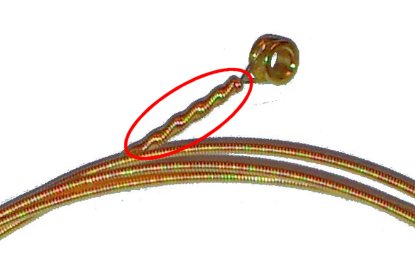
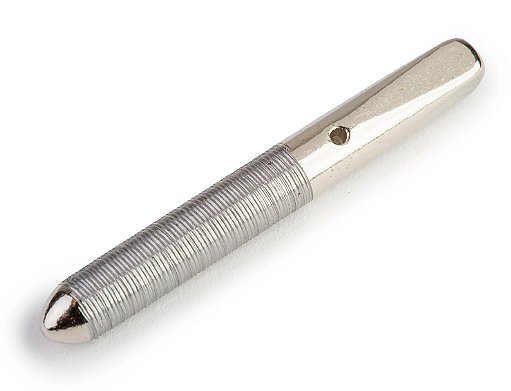
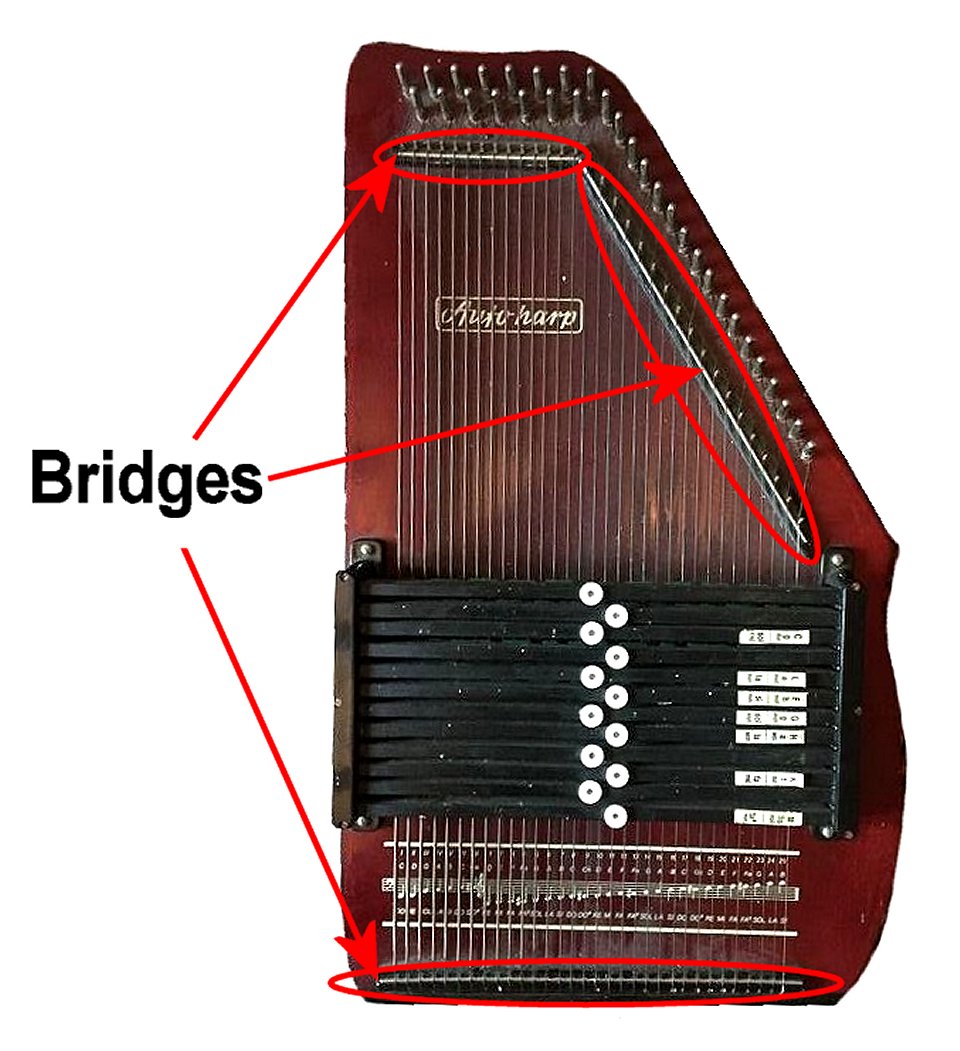
On Replacing "Wound" Strings: This is more complex. Wound guitar strings have windings that go almost the entire length of the string - they need that for intonation. Wound autoharp strings, on the other hand, only have windings on the part between the bridges. This allows them to vibrate more freely for better tone. So, even if you can get them to work, they won't be optimum. If you have a "Type B" autoharp, you might have trouble getting the fatter strings installed period. Some folks have figured out way to remove the windings on that part of a guitar string without making the ball come loose. If you can remove the windings to just where it passes the "bridge" part of the anchor bar, that's a good thing. But it's pretty fiddly, and most folks have to try it a few times before they can do it consistently. That said, a "ball end" guitar string might be worth trying if you have a "Type B." If you have a "Type A," a loop-end banjo string will be better. If you can't find one in the gauge you need, you might be able to use a ball-end guitar string. Finally, it's worth pointing out that wound strings lose their tone faster than unwound strings. So if you get to the point where you have to order real autoharp strings to replace some of the lower strings, you might look into replacing all of the wound strings at the same time. Folks who've done this claim it improves their autoharp sound significantly. Unwind Before You Wind
This happens most often when the string is missing altogether, or when you can easily pull the remaining bit off of the tuning peg with your fingers. Don't be tempted to just pop the new string on without unwinding the peg a little first. By "unwinding" or loosening the peg as much as you expect to tighten it when the new string goes on, you protect your "pin block." Notch, then Wind As a guitar player, I'm frankly used to poking the new string all the way through the peg, bending it on both sides to help lock it in place, and then winding the new string on so that it goes around the peg three or more times. I'm told that's not the best way to do autoharp strings. Pete D'Aigle and his coworker Hal Weeks now recommend a different approach that makes changing strings much easier in the future. First, of course, you take off the cover that protects the end of the strings. On older autoharps, it's a strip of wood or plastic. On newer ones, it's a metal strip that screws onto the front of the autoharp. Then attach the loop or ball end of the string to the peg or anchor bar. Holding it in place on that end, feed the other end up through until it comes out by the tuning pegs. Make certain it hasn't wrapped around any other strings, etc. Pull the open end of the string past the tuning peg an inch or so, then clip it off. Using a needlenose plier, make a little "shepherd's hook" in that end. Then hook the "shepherds's hook" into the hole in the peg, without going all the way through the peg. Being careful to keep the loop or ball end in place, tighten the peg until the string is taught. Then tune. Theoretically, if you ever need to replace that string, it will come off much easier. However, I confess that I still leave enough "slack" to give me 2-3 windings on each peg. Videos The internet has plenty of videos on how to replace autoharp strings. Here are some from people I trust: Replacing Entire SetsWhen you decide to upgrade to a new string set, be sure to order the best you can buy. There's a lot of work involved, and many folks who've "saved" $30 by buying second-tier strings have wished they had made better choices.As of November, 2025, the best strings by far are made by Greg Schreiber, a former autoharp bulder/repairman. As I understand it, Greg inherited the string-making equipment from Tom Fladmark, who inherited it from George Orthey, who bought it from American Windings when they went out of business. To George, Tom, and Greg, making qality strings available has always been a "labor of love."
Greg's strings are also available from Pete D'Aigle, an autoharp luthier. P.S. I'm told that Pete's shop has its own stringmaking equipment, but their autoharp-building business consumes all the strings they can produce. At the moment, Greg's strings are also available from the AutoharpStore. All at Once or??? Some folks like to replace a string at a time so the instrument stays under tension. This works best for folks who don't need any other maintenance at this time. Some folks like to replace the strings all at once so they reach a point when the top can be cleaned and polished, and maybe even refinished. If you have a "Type B" autoharp, It is also a good time to consider screwing down the anchor bar to avoid future problems. (See Hal Week's video on this subject for more information.) The only downside of this I can think of is that all of the tension is taken off the instrument at the same time, so it will take longer to get and stay in tune when the new strings are put on it. If you do decide to take all the strings off at the same time, do not take them off in sequence. Those strings are putting 1500 pounds of pressure on your autohar frame, so you want to relieve the tension evenly. Some people take of one low string, then one high string, and so on. The videos on string replacement above will guide you through the process. String GaugesThe following table shows the most common string gauges used on Oscar Schmidt autoharps. It's most useful if you're hoping to replace a string or two with guitar strings (discussed above).Also, if you have a partial set of autoharp strings, and you break a string that you don't have a replacement for, you can tell if one of the new strings you do have would substitute. (If not, I would probaby choose the next lighter one, rather than the next heavier one, just to avoid putting unnecessary stress on the frame. Though it probaby wouldn't make that much difference - I would just rather "err on the side of caution.") Once again, if you need a bunch of strings, Greg Schreiber and his resellers are the best source. Also, if you have a Chromaharp or any alternative Oscar Schmidts (OS-6, OS-10, etc.), Greg can help you. Finally, if your autoharp is not an Oscar Schmidt or Chromaharp, please jump to the "Custom Strings" section further down. Custom StringsThe string chart above works for Oscar Schmidt 36 and 37-string autoharps. But not for other brands.As of this writing (December, 2025), you can order a complete set for most Chromaharp autoharps from Greg Schreiber So just listing the string schedule like that above doesn't do it. As long as Greg Schreiber is in business, you should be able to get strings or any autoharp or zither from him, although custom strings will cost you more.
Remember to "unwind" the tuning peg a little before you install the new string. ConclusionSince every article I post attracts more reader questions, I wouldn't be surprised if this article gets additions, tweaks, or maybe even corrections in the future. I welcome the chance to make things clearer, and - when possible - more accurate.As I have time, I'll write more about other issues or problems you may encounter. In the meantime, I hope our available articles help answer your questions about these under-rated instruments.
And please stay in touch! - Paul Race
All material, illustrations, and content of this web site is copyrighted ? 2001, 2002, 2003, 2004, 2005, 2006,
For questions, comments, suggestions, trouble reports, etc. about this page or this site, please contact us.
| |||||||||||||||||||||||||||||||||||||||||||||||||||||||||||||||||||||||||||||||||||||||||||||||||||||||||||||||||||||||||||||||||||||||||||||||||||||||||||||||||||||