



|
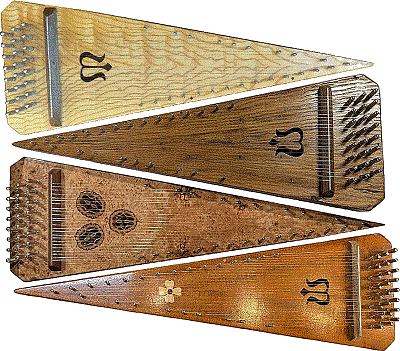 Archie Smith Bowed Psalteries Archie Smith Bowed Psalteries
Archie Smith, working in Mt. Pleasant, North Carolina, prided himself on being a woodworker following the traditions of "Old World Craftsmen" in the way he approached building his psalteries and Appalachian dulcimers.
That said, Archie generally followed time-honored blueprints when he built his instruments.
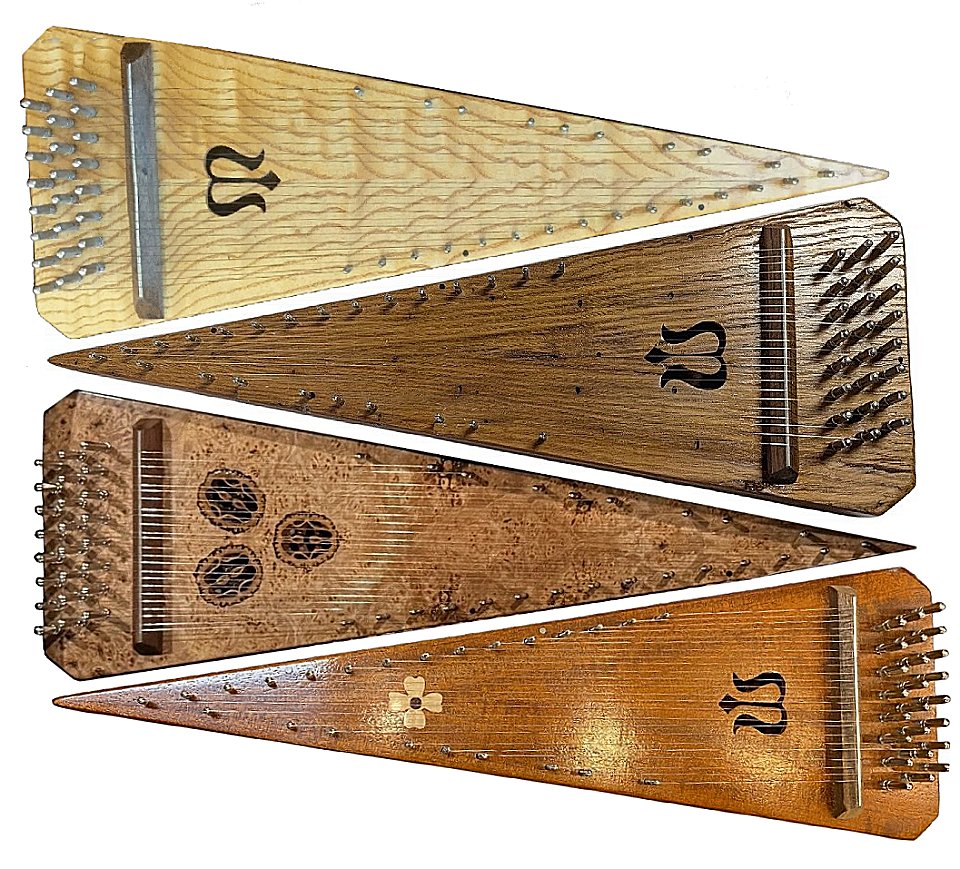
What made his unique was the level of craftsmanship and the beautiful and unusual materials he chose to use. The sound and playability of each instrument is on a par with other professionally-built instruments of his day. But Archie also elevated them to works of art.
According to an old article in CarolinaDesignerCraftsmen.com, Archie said:
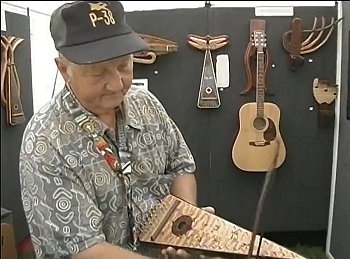 I work alone. I plan and design, “scout out” sources (from over the world) and acquire the varied and specific materials that I want. I then cut, saw, resaw, bookmatch, glue, sign, date, number, drill, clamp, trim, carve, cut out and prepare various materials for inlay. I do the inlay work itself, shape, sand, spray, buff, press in anchors, screw in tuners, string, tune and play my instruments. (I also sweep up the sawdust.) I work alone. I plan and design, “scout out” sources (from over the world) and acquire the varied and specific materials that I want. I then cut, saw, resaw, bookmatch, glue, sign, date, number, drill, clamp, trim, carve, cut out and prepare various materials for inlay. I do the inlay work itself, shape, sand, spray, buff, press in anchors, screw in tuners, string, tune and play my instruments. (I also sweep up the sawdust.)
I make three types of instruments: the mountain or lap dulcimer; the bowed psaltery; the plucked psaltery. All three are wooden string instruments and all three have their own type of “voice.” In the creation of my instruments I expend much “tender love and care,” as well as much “blood, sweat, toil and tears.”
People often ask me how long it takes to make one of my instruments. In all honesty, I have to answer that I really don’t know. I do not (I can not) keep account of how long it takes and I really do not want to know because it is a labor of love. It simply takes as long as it takes.
Archie's instruments carry the "Horsebottom Ridge" stamp, named after a place Archie lived for a while.
You can see by the photos near the top of the page that he experimented with many different materials and trims.
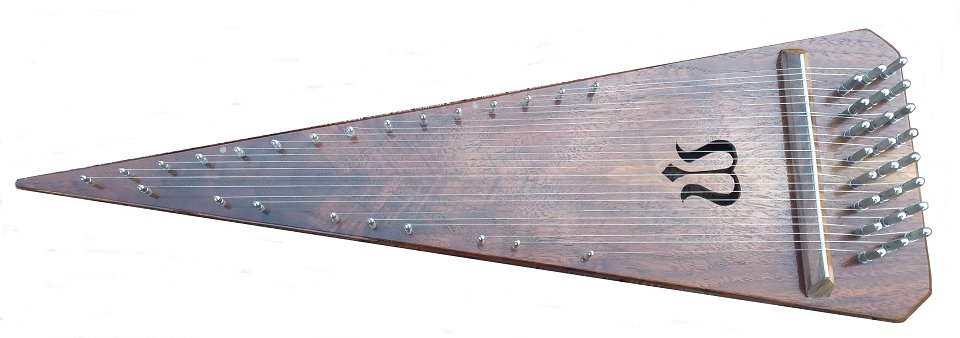
The single Horsebottom Ridge psaltery I own seems to be solid walnut with a fancy "W" cut into the face. This figure confuses some newbies, because they imagine it indicates the maker (sometimes citing the Westmans, who never actually used that figure).
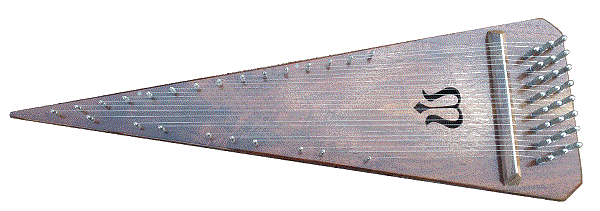
The truth is, that fancy "W" was adopted by any number of early psaltery builders because it adds an acoustic characteristic to the instrument similar to the "F-holes" on classic violins. Literally, the air vibrating in and out of those complex shapes makes the tone more complex. (Sorry, my one-time music-major education leaking through . . . . ). That said, the difference it makes isn't "night and day," so most psaltery builders choose other means of enhancing the tone or appearance.
The top and back are bookmatched. The tone is rich and sweet.
The only issue I had with it is that it is so narrow that the strings are very close to each other, limiting the angle at which you can bow them.
I'm sure I'd get used to it if it was my primary instrument.
Other Horsebottom Ridge psalteries spotted with the "W" tonehole include:
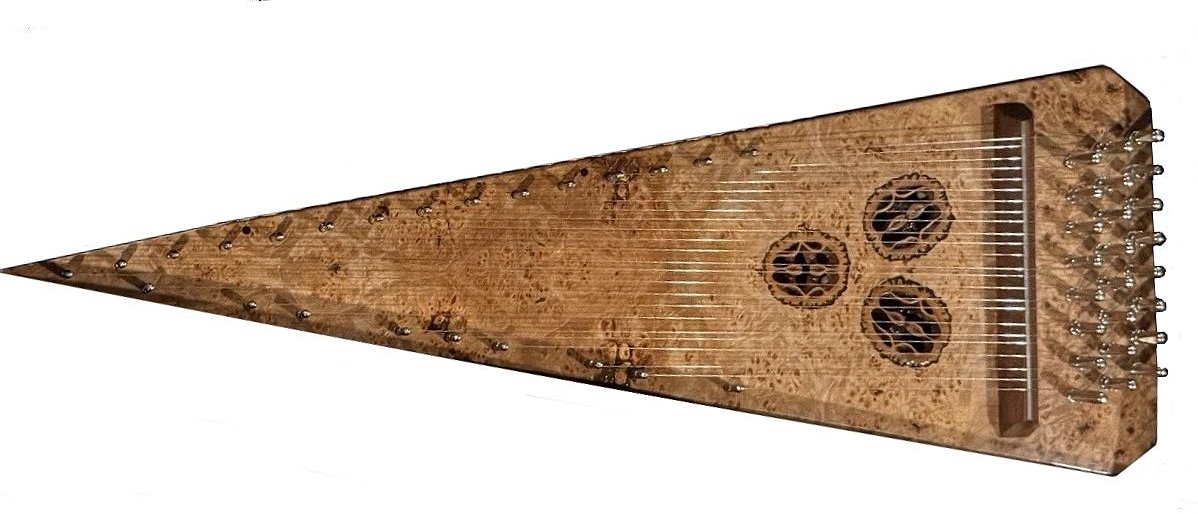
One of Archie Smith psaltery styles I especially admire is the one that uses black walnut cross-sections for the sound hole.
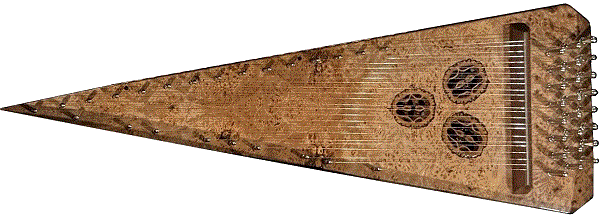
These psalteries usually use some other premium wood for the top, such as birds-eye maple, but since the paperwork is lost on most of them, it would take an expert to positively identify what Archie used on most that turn up.
Are They Still Available? Archie retired in 2017, due to health and other issues. So there haven't been any new ones for almost a decade.
Examples of the instruments listed above were available for sale in early September, 2026, on eBay, Reverb.com, and similar sites. I saved the photos for this article, so you could see the crazy variety Archie was able to inject into essentially the same blueprint.
Several of them were sold by the time I posted this article, so I'm not bothering to provide any links. However, you might by able to find similar examples by doing a Google image search on any of the photos I've provided.
That said, most people want a great deal for the ones that they post, and they're probably worth it. I got my walnut Horsebottom Ridge example inexpensively at an auction because the company selling it didn't know what it was. In other words, keep your eye out.
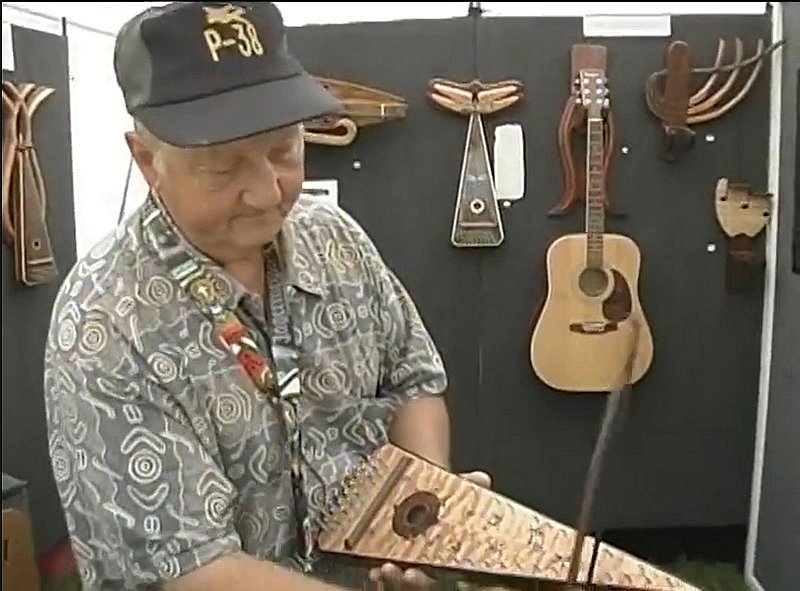
Archie in Action - Here's a video of Archie demonstrating two of his instruments: https://www.youtube.com/watch?v=iBlUhJF7vok
Archie's Legacy - Most people will be amazed at the tone of any well-made bowed psaltery. But most of Archie's instruments are "jaw-droppers" even before you start playing them.
Accessories that came with the psalteries included.
Tuning and Restringing - Tuning a bowed psaltery is a lot like tuning an autoharp or zither. The tuning wrench is similar and, in many cases, interchangeable.
If the psaltery is way out of tune, tuning to a keyboard first can help you get it close faster than trying to use a digital tuner - which may not guess properly which note you're trying to tune.
Restringing is the same as for most other bowed psalteries (Unicorn Strings being an exception).
- Buy extra strings. Most autoharps use .010-diameter strings (what guitarists call 10-gauge. You may buy guitar strings, though you won't use the little ball at the end unless your autoharp has already been strung that way. On most psalteries, a single guitar string will give you 2-3 psaltery strings.
- If you're replacing a broken string, back out the tuning peg about two complete turns before you get started. This will help you keep from drilling tuning peg too far down into the pin block.
- Examine carefully how the remaining strings are fastened.
- Put one end of the string through the hole near the base of the hitch pin, starting with the hole closest to the bridge so that it comes out the otehr side.
- Leave a quarter of an inch or so on the "south" side of the peg and notch it so it will stay.
- Bring the wire upwards from the "north" hole, notching it again as you do.
- Bring the wire over the top of the hitch pin, settling it in the slot.
- Bring the wire across the bridge and through the hole on the approprate tuning peg.
- Draw the wire through the hole all the way.
- Cut off the wire about two inches away from the tuning peg.
- Pull the wire back until about 1/4" is sticking out. Notch the wire there. Most installations would have you bending it downward against the tuning peg to notch it.
- Holding the wire with one hand to keep the tension on it, start turning the tuning peg to tighten it up. Look to see how the wires are wound around the other tuning pegs and copy that.
- When the wire has snugged up, begin to tune.
- When the string comes loose or breaks, thank me for telling you to buy extra, figure out what you did wrong, and try again.
Dave Lucas' psalteries were undoubtedly a labor of love, and each one I've seen shows good materials and craftsmanshop. If you come across one, give it a try. You won't regret it.
For More Information
Conclusion
Like most of the articles on our HarpersGuild and CreekDontRise pages, this article came as a result of reader inquiries, and discovering that much of the "information" on these things was either patchy or unreliable. So I've picked up a few different pieces to make certain what I was writing about them was correct and tracked down what seem to be the most reliable sources of information.
That said, if you have a correction or a question, please contact me and I'll be glad to hear from you.
Also, if you make or play bowed psalteries, and want to provide additional information, corrections, etc. we'd be glad to hear from you.
 Whatever else you get out of our pages, I hope you come away with some great ideas for "sharing the joy." Whatever else you get out of our pages, I hope you come away with some great ideas for "sharing the joy."
And please stay in touch!
- Paul Race


| > |
|
|
All material, illustrations, and content of this web site is copyrighted ? 2001, 2002, 2003, 2004, 2005, 2006, 2007, 2008, 2009,
2010, 2011, 2012, 2013, 2014, 2015, 2016, 2017, 2018, 2019, 2020, 2021, 2022, 2023, 2024, 2025 by Paul D. Race. All rights reserved.
HarpersGuild(tm) is a participant in the Amazon Services LLC Associates Program, an affiliate advertising
program designed to provide a means for sites to earn advertising fees by advertising and linking to Amazon.com.
Note: Creek Don't Rise (tm) is Paul Race's name for his resources supporting the history and music of the North American Heartland as well as additional kinds of acoustic and traditional music.
For questions, comments, suggestions, trouble reports, etc. about this page or this site, please
contact us.
| Visit related pages and affiliated sites: |
| - Music - |

|
 |
 |

|

|

|

|

|

|

|

|

|

|

|

|

|

|

|
| - Trains and Hobbies - |

|

|

|  |
 |

|
| - Christmas Memories and Collectibles - |
 |

|
 |

|
 |

|
| - Family Activities and Crafts - |
 |

|

|

|

|

|
|