Click to go to the harpersguild.com(tm) home page

Dave Lucas Bowed Psalteries


Click to visit RiverBoatMusic.com's bowed psaltery buyers' guide.
Please Read: How to Help Our Site at No Cost to You - Some of our articles contain recommendations for products we like and vendors we personally trust. Some of those vendors may pay us a very small commission if you click on a link and buy their products. This costs you nothing at all and helps offset the costs of what we do. So if we point you to something you decide to buy later, please make certain you come back through our site and click on the link directly. Thanks.

This Site is a Cookie-Free Zone - Except for discussion forums that you have to expressly register for, none of our pages use cookies of any kind. Some of the vendors we link to do, but that won't affect you unless you click on a link to their pages. Your continued use of this page indicates that you agree to our policy. For details, click here.


Click to sign up for our newsletter about Folk, Roots, and Americana music.


Click to visit RiverBoatMusic.com's autoharp buyers' guide.


Click to visit RiverBoatMusic.com's acoustic guitar buyers' guides


Click to visit RiverBoatMusic.com's banjo buyers' guides
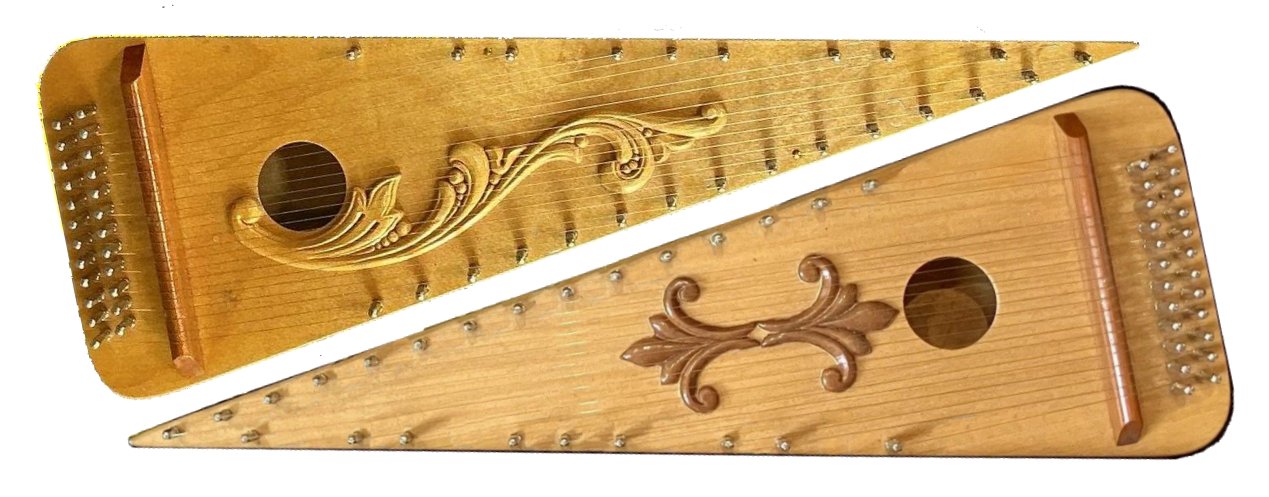
Two typical Dave Lucas psalteries with the glued-on wood trim.  Click for bigger photo.

Dave Lucas Bowed Psalteries

Dave Lucas built over 5000 bowed psalteries in the decades leading up to 2020, when he apparently stopped building. Most of his were 2 octaves, though some were three.

Characteristics of Dave's psalteries generally include:

  • Trims that made each instrument unique. Most of those I've seen had glued-on wood trim pieces, but a few had paintings, courtesy of Paulette.

  • A primitive-style bow that was easy to rehair if you needed to

  • Stickers for numbering each string. (Most builders would use note names instead, but Dave's wife Paulette wrote three booklets that showed how to play well-known Folk songs by the numbers.)

Resonator Feature Many of Dave's psalteries included a sort of "second back," set off from the true back by little wooden blocks.
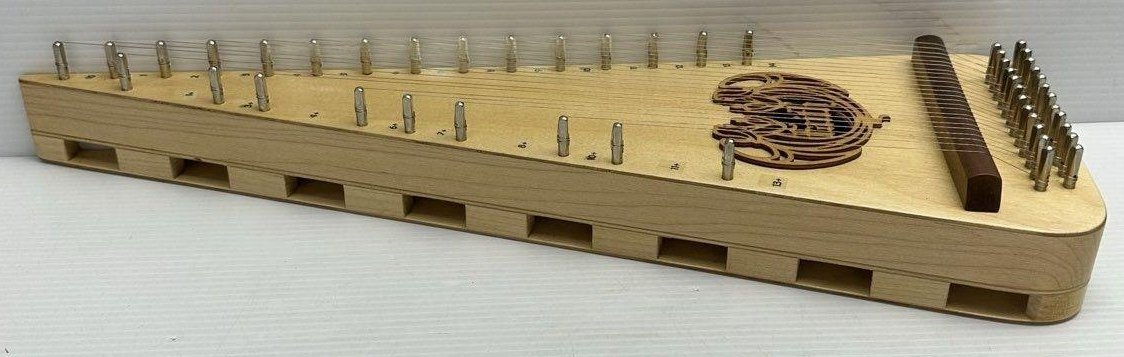
A Dave Lucas psaltery with the second back 'resonator' attachment. Click for bigger photo.

In instruments like banjo, autoharp, and dulcimer resonators, "possum boards," and similar features keep the sound from the back of the instrument from being absorbed by the player's body and clothing. Whether it makes much difference on bowed psalteries depends on how you hold the instrument. But it's a nice, attractive touch, regardless.

To me, Dave's psalteries have a sweet sound and good sustain.

Could they be louder? Some folks imagine that the glued-on wood flourishes affect the volume. Others complain about the bridge not coming to a sharper point (or using a harder material), but it does cut down on broken strings.

Personally, I'd feel fine taking a Dave Lucas psaltery into any session.

Accessories that came with the psalteries included.

  • Bow - Dave included a primitive-style bow with each psaltery. Many folks prefer a more professional-looking bow, but this setup gives you the ability to easily change the tension, or to change the horsehair if it comes to that.

    The bow that came with Dave's psalteries.  Easy to ajust and - if necessary - to rehair.  Click for bigger photo.

    That said, a bow from any other American manufacturer should work just fine, if you don't get a usable bow with yours.

  • Rosin - A block of rosin. Different Dave Lucas psalteries have come to me with different brands and styles of resin, so I'm not sure which is original

  • Tuning Wrench - A standard tuning wrench, similar to that used on autoharps and zithers. Personally, I think a "T"-shaped tuning wrench will do you more good in the long run - it puts the same amount of pressure on all sides of the tuning pegs.

  • Note Number Stickers Removable clear plastic stickers with the note numbers. (Note, if they're not already attached to a psaltery you receive, you're better off finding a set of note name stickers or getting used to playing without stickers at all.)

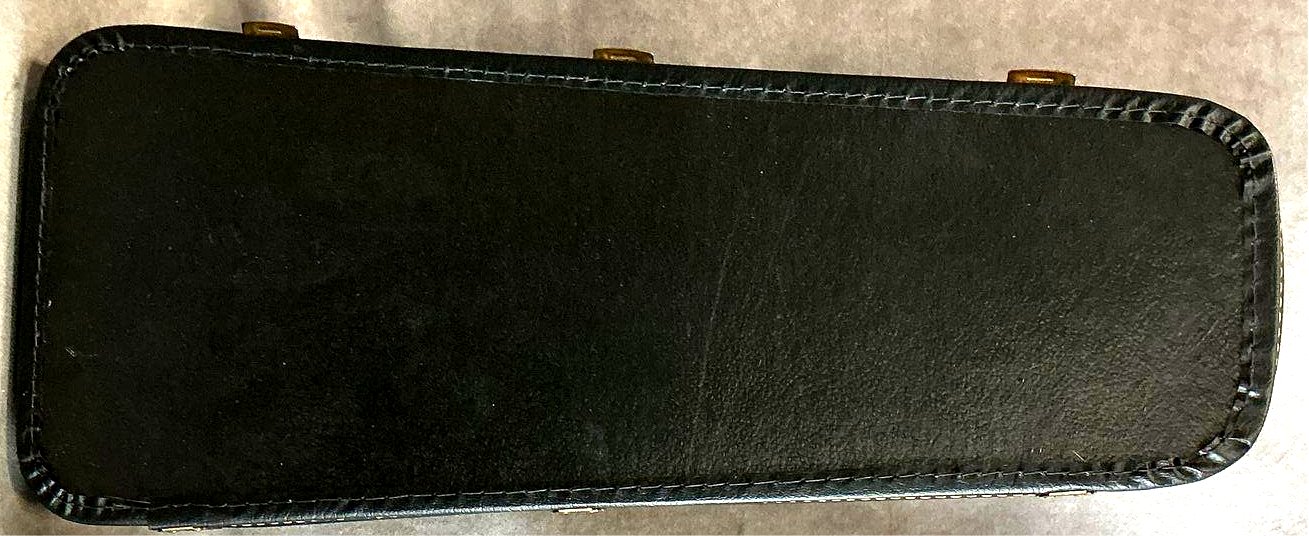
  • Most Dave Lucas psalteries I've come across still have the 'chipboard' (cardboard) case. It's great for storage and for taking your psaltery out of the house, but it's not solid enough to protect your psaltery if someone throws a suitcase on top of it.Case - These usually seem to have come with a custom "chipboard" (cardboard) case. They're not as rugged as a real case but they keep the dust off your instrument and make it easy to carry. That said, don't throw your psaltery in the trunk of your car then throw the suitcases on top.

  • Booklets - Paulette wrote three song booklets that allowed you to play well-known Folk songs by using the numbering system. Unfortunately, that system is unique to Dave Lucas psalteries - you're better off learning to use note names.

Tuning and Restringing - Tuning a bowed psaltery is a lot like tuning an autoharp or zither. The tuning wrench is similar and, in many cases, interchangeable.

If the psaltery is way out of tune, tuning to a keyboard first can help you get it close faster than trying to use a digital tuner - which may not guess properly which note you're trying to tune.

Restringing is the same as for most other bowed psalteries (Unicorn Strings being an exception).

  • Buy extra strings. Most autoharps use .010-diameter strings (what guitarists call 10-gauge. You may buy guitar strings, though you won't use the little ball at the end unless your autoharp has already been strung that way. On most psalteries, a single guitar string will give you 2-3 psaltery strings.

  • If you're replacing a broken string, back out the tuning peg about two complete turns before you get started. This will help you keep from drilling tuning peg too far down into the pin block.

  • Examine carefully how the remaining strings are fastened.

  • Put one end of the string through the hole near the base of the hitch pin, starting with the hole closest to the bridge so that it comes out the otehr side.

  • Leave a quarter of an inch or so on the "south" side of the peg and notch it so it will stay.

  • Bring the wire upwards from the "north" hole, notching it again as you do.

  • Bring the wire over the top of the hitch pin, settling it in the slot.

  • Bring the wire across the bridge and through the hole on the approprate tuning peg.

  • Draw the wire through the hole all the way.

  • Cut off the wire about two inches away from the tuning peg.

  • Pull the wire back until about 1/4" is sticking out. Notch the wire there. Most installations would have you bending it downward against the tuning peg to notch it.

  • Holding the wire with one hand to keep the tension on it, start turning the tuning peg to tighten it up. Look to see how the wires are wound around the other tuning pegs and copy that.

  • When the wire has snugged up, begin to tune.

  • When the string comes loose or breaks, thank me for telling you to buy extra, figure out what you did wrong, and try again.

Dave Lucas' psalteries were undoubtedly a labor of love, and each one I've seen shows good materials and craftsmanshop. If you come across one, give it a try. You won't regret it.

For More Information

Conclusion

Like most of the articles on our HarpersGuild and CreekDontRise pages, this article came as a result of reader inquiries, and discovering that much of the "information" on these things was either patchy or unreliable. So I've picked up a few different pieces to make certain what I was writing about them was correct and tracked down what seem to be the most reliable sources of information.

That said, if you have a correction or a question, please contact me and I'll be glad to hear from you.

Also, if you make or play bowed psalteries, and want to provide additional information, corrections, etc. we'd be glad to hear from you.


Paul Race playing an autoharp. Click to go to Paul's music home page.Whatever else you get out of our pages, I hope you come away with some great ideas for "sharing the joy."

And please stay in touch!

    - Paul Race Click to see Paul's music home page Click to contact Paul through this page. Click to see Paul's music blog page Click to learn about our Momma Don't Low Newsletter. Click to see Paul's music page on Facebook Click to see Paul's YouTube Channel.

>

All material, illustrations, and content of this web site is copyrighted ? 2001, 2002, 2003, 2004, 2005, 2006, 2007, 2008, 2009,
2010, 2011, 2012, 2013, 2014, 2015, 2016, 2017, 2018, 2019, 2020, 2021, 2022, 2023, 2024, 2025 by Paul D. Race. All rights reserved.
HarpersGuild(tm) is a participant in the Amazon Services LLC Associates Program, an affiliate advertising
program designed to provide a means for sites to earn advertising fees by advertising and linking to Amazon.com.

Note: Creek Don't Rise (tm) is Paul Race's name for his resources supporting the history and music of the North American Heartland as well as additional kinds of acoustic and traditional music.

For questions, comments, suggestions, trouble reports, etc. about this page or this site, please contact us.


Visit related pages and affiliated sites:
- Music -
Heartland-inspired music, history, and acoustic instrument tips.
Best-loved railroad songs and the stories behind them.
Learn important guitar chords quickly, to jump start your ability to play along on any song. With a few tools and an hour or two of work, you can make your guitar, banjo, or mandolin much more responsive.  Instruments with movable bridges can have better-than-new intonation as well. Resources for learning Folk Music and instruments quickly Check out our article on finding good used guitars.
Carols of many countries, including music, lyrics, and the story behind the songs. X and Y-generation Christians take Contemporary Christian music, including worship, for granted, but the first generation of Contemporary Christian musicians faced strong, and often bitter resistance. Different kinds of music call for different kinds of banjos.  Just trying to steer you in the right direction. New, used, or vintage - tips for whatever your needs and preferences. Wax recordings from the early 1900s, mostly collected by George Nelson.  Download them all for a 'period' album. Explains the various kinds of acoustic guitar and what to look for in each.
Look to Riverboat Music buyers' guide for descriptions of musical instruments by people who play musical instruments. Learn 5-string banjo at your own speed, with many examples and user-friendly explanations. Explains the various kinds of banjos and what each is good for. Learn more about our newsletter for roots-based and acoustic music. Folks with Bb or Eb instruments can contribute to worship services, but the WAY they do depends on the way the worship leader approaches the music. A page devoted to some of Paul's own music endeavors.
- Trains and Hobbies -
Free building projects for your vintage railroad or Christmas village.
Visit Lionel Trains. Click to see Thomas Kinkaded-inspired Holiday Trains and Villages. Big Christmas Train Primer: Choosing and using model trains with holiday themes Building temporary and permanent railroads with big model trains Click to see HO scale trains with your favorite team's colors.
- Christmas Memories and Collectibles -
Visit the FamilyChristmasOnline site. Visit Howard Lamey's glitterhouse gallery, with free project plans, graphics, and instructions. Click to return to the Old Christmas Tree Lights Table of Contents Page Click to sign up for Maria Cudequest's craft and collectibles blog.
Click to visit Fred's Noel-Kat store.
Visit the largest and most complete cardboard Christmas 'Putz' house resource on the Internet.
- Family Activities and Crafts -
Click to see reviews of our favorite family-friendly Christmas movies. Free, Family-Friendly Christmas Stories Decorate your tree the old-fashioned way with these kid-friendly projects. Free plans and instructions for starting a hobby building vintage-style cardboard Christmas houses. Click to find free, family-friendly Christmas poems and - in some cases - their stories. Traditional Home-Made Ornaments