

|
 Canadian Pushbutton Autoharp Canadian Pushbutton Autoharp
Soon after Karl August Gutter, of Markneukirchen, Germany invented what we know as the autoharp and sold his patent to another Bavarian, Herman Lindemann, countless builders like C.F. Zimmerman, began copying his invention, mostly without payment to the patent owner.
Of course, by about 1910, Gutter's patent had run its course, allowing even the most concientious builder to borrow - and to build on - Gutter's invention.
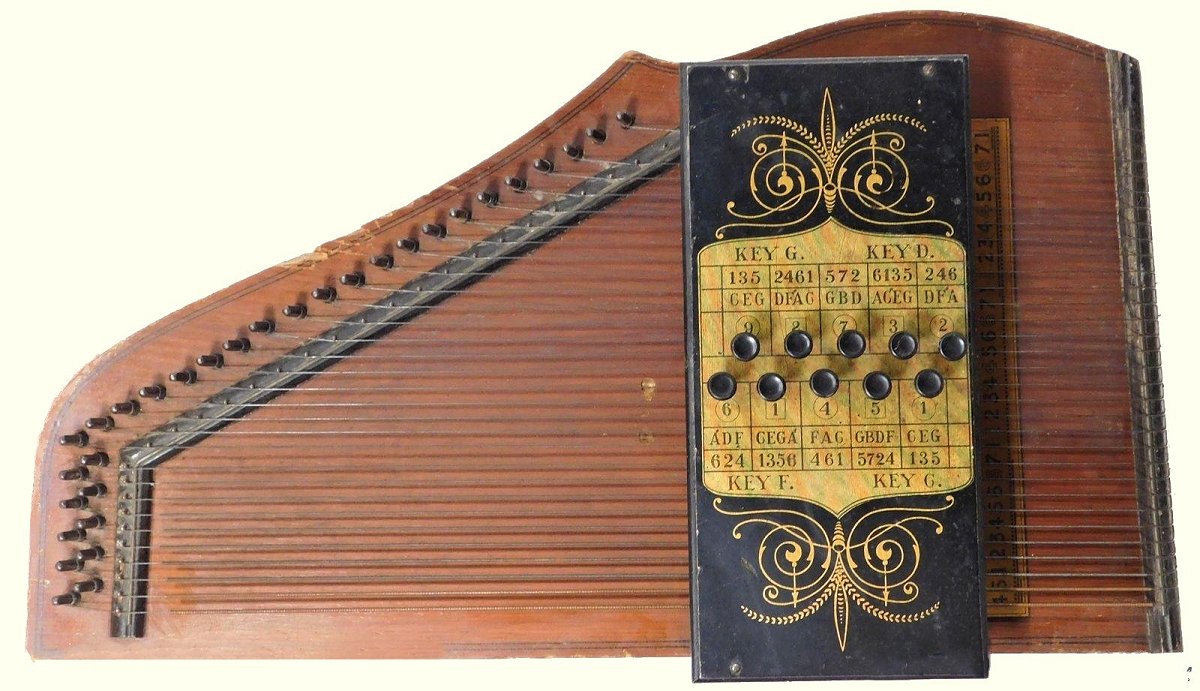
One of these variations likely emerged in Canada about 1910. Very few have survived, but they have appeared in Canada, the UK, Australia, and New Zealand. A few have even appeared in the United States, where the Zimmerman/Dolge/Phonoharp/Oscar Schmidt autoharp dynasty ruled.
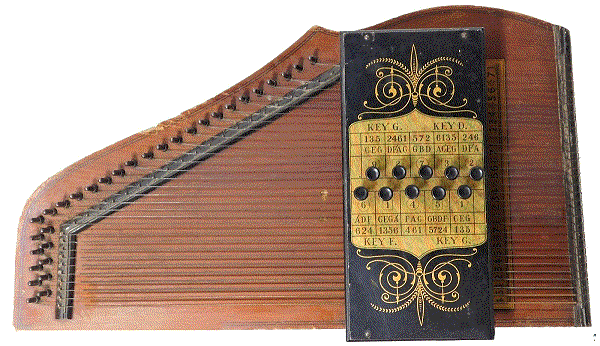
Sadly, they're not worth a great deal today, even if they turn up in great condition. Buf they were pretty clever in their day. Unlike most of their competition, they enabled you to play 3-chord songs in F, C, G, and D. Easily.
This month, another autoharp newbie came up with one and was inundated with erroneous information and bad advice, so I thought it would be worthwhile to publish what my research has turned up.
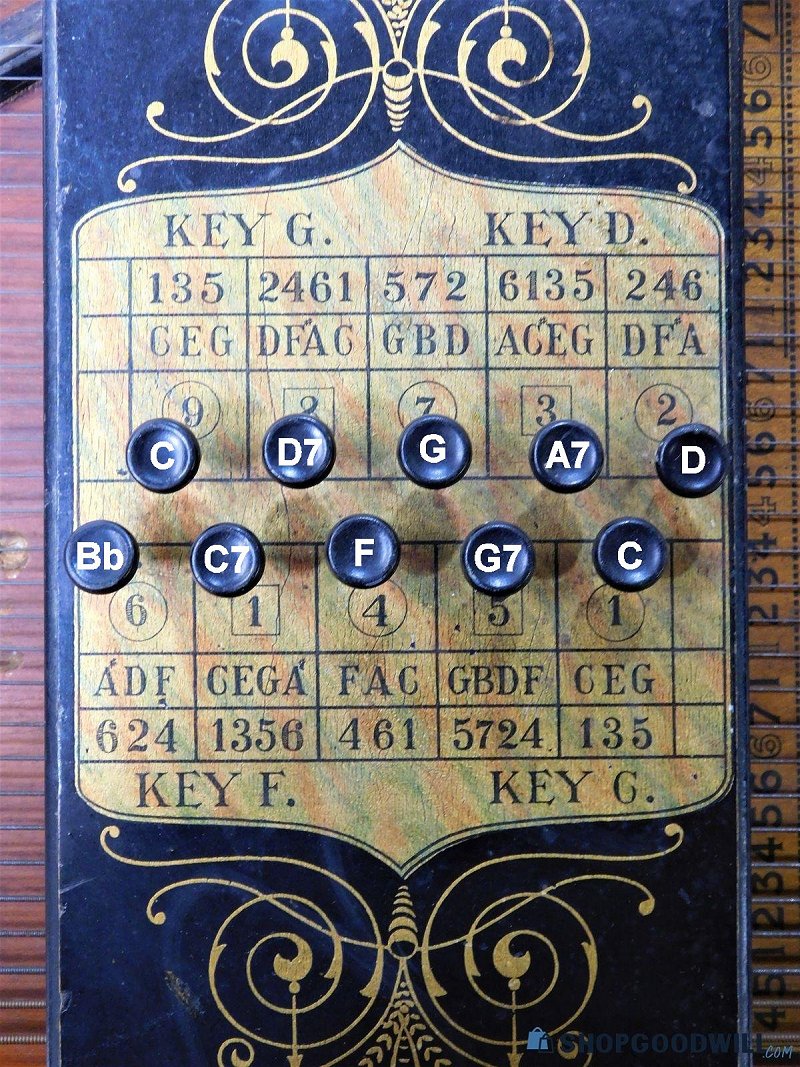
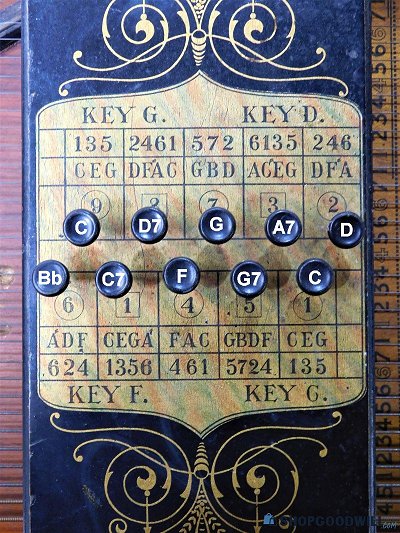 To help you make sense of the following bits, we've superimposed the modern chord names over each of the buttons in the picture to the right. To help you make sense of the following bits, we've superimposed the modern chord names over each of the buttons in the picture to the right.
Archaic Labeling Practices
To understand what notes are in each chord, you need to know that, according to German practice that dominated most zither and autoharp labeling before 1930, the "A" on the Bb and C7 chords is really Bb, the "C" on the A chord is really a C#, and the "F" on the D chord is really F#.
The manufacturers demonstrated the difference by shading the numbers above the note names differently. The note names for A#,C#, and F# also received a microscopic "sharp sign."
The chord numbering convention is a little harder to sort out. It's roughly based on a chord numbering convention C.F. Zimmerman adopted so his customers wouldn't have to learn to read sheet music.
It's based on the idea that C is always "1," no matter what key you're playing in. D is always "2", and so on. Bb is shown as 6 with a funny font, Zimmerman's way of showing A#.
Don't bother trying to make sense of it, because it's not fully consistent on this instrument. My guess is that the manufacturer had its own system that wasn't exactly like Zimmerman's.
But you will notice that the numbers for the major chords are all drawn in circles, while the numbers for the seventh chords are all drawn in squares. Which will help you see the pattern of their very helpful chord arrangement.
Easy 3-Chord Playing in Four Keys
When these autoharps were built, there were thousands of well-known songs that used only three chords. Of course, today, there are hundreds of thousands.
So these instruments were built to make playing those songs as easily as possible in as many keys as possible.
For convenience, the chords for each key were arranged exactly the same way - IV-V7-I. So:
- Songs in the key of G would use the chords C (C, E, G), D7 (D, F#, A, C), and G (G, B, D)
- Songs in the key of D would use the chords G (G, B, D), A7 (A, C#, E, G), and D (D, F#, A)
- Songs in the key of F would use the chords Bb (Bb, D, F), C7 (C, E, G, Bb), and F (F, A, C).
- Songs in the key of C would use the chords F (F, A, C), G7 (G, B, D, F), and C (C, E, G).
If you actually acquire one of these with good strings, felts, and springs, and you can get it in tune, you can have a lot of fun with it.
Unfortunately, that's a lot of "ifs." I would not recommend spending a great deal of time, energy, or money, restoring one to playability unless it had great sentimantl value or some such.
The "Zither Scale"
When it came to the melody strings, it was common for chorded zithers of that era to have a semi-chromatic scale, lacking Eb(D#) and Ab(G#). They technically weren't needed, since none of the chords they could play used those notes. This autoharp followed this pattern.
C# was also missing from many chorded zithers of the era, but it's included here, because it's needed for the A7 chord.
The strip that showed the string numbers is shown below. Hollow numbers mean 'sharp.' so the extra 1, 4, and 6 represent C#, F#, and A# respectively.

Based on this graphic, the notes (starting with the bass strings) are:
F, G, C, D, E, F, A, Bb, B, C, C#, D, E, F, F#, G, A, Bb, B, C, C#, D, E, F, F#, G, A, Bb, B, C.
F# and C# weren't included in the lower octave because they weren't the bass notes of any chord. And having them sound in the lower octave would have made the chords sound "muddy" because of the clashing overtones they would generate.
For zither manufacturers of this era, leaving off notes you'd never use on that instrument both saved money and kept the instrument size manageable. In fact, the Zimmerman 5-chorders of the time had a diatonic scale except for Bb. (The Model 73, on the other hand, had a full chromatic scale in the middle and top octave, even though the Eb/D# string was never played by any of its chords.)
Wouldn't it be easier to pick out the melody on an instrument that had a fully chromatic scale? Probably, but in those days, the manufacturers' "play-by-number" music sheets took the guesswork out of which string to pluck.
Who Made These?
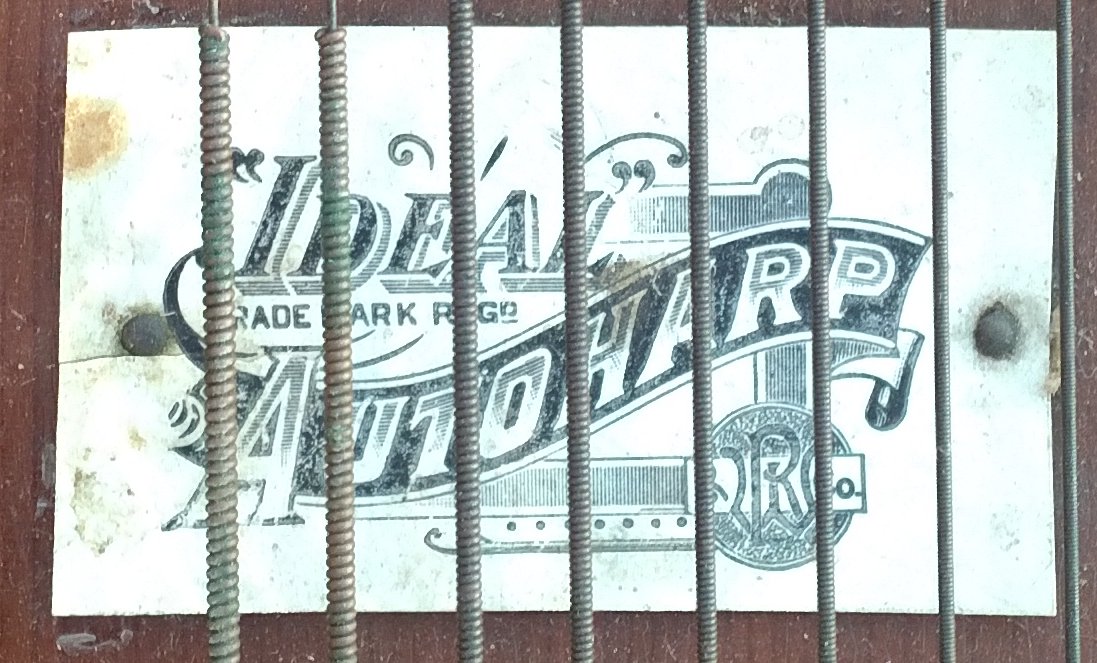
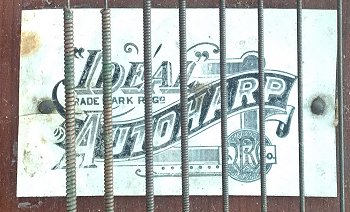 One problem with reporting on these is that almost none of them have any brand names or indication of manufacture The one I owned had the "Ideal" logo shown at the right, but I've never seen that on any of the other examples that turned up. One problem with reporting on these is that almost none of them have any brand names or indication of manufacture The one I owned had the "Ideal" logo shown at the right, but I've never seen that on any of the other examples that turned up.
The first autoharps I came across with this configuration were in the UK, so I wondered if they were built there. But then, I encountered several in Canada and a few "down under."
Gradually, I stumbled across more clues that these were built in Canada. They tended to be advertised by Canadian companies, although the exact manufacturer information was seldom included.
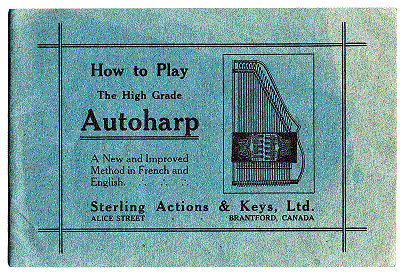 One source says that these seem to have been made by the "Rex Company in Toronto and Sterling Actions and Keys, Limited out of Brantford/Toronto." One source says that these seem to have been made by the "Rex Company in Toronto and Sterling Actions and Keys, Limited out of Brantford/Toronto."
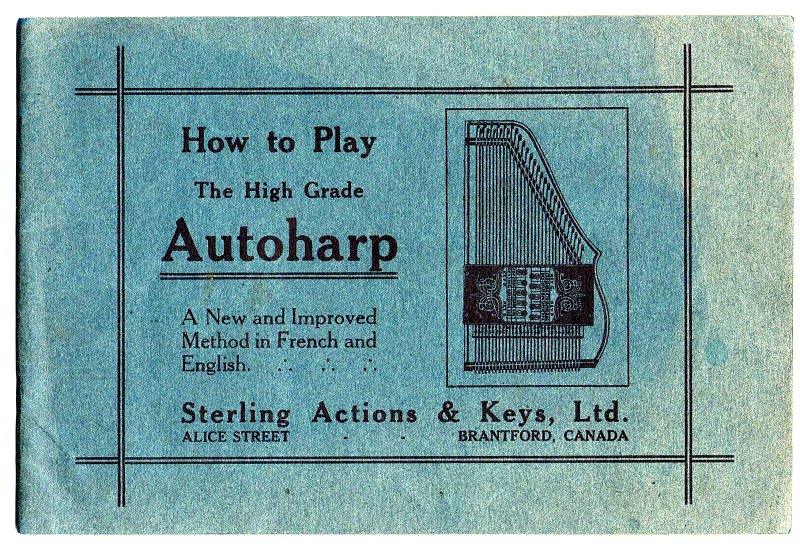
I was able to track down this booklet cover from Sterling Actions and Keys; it features the autoharp in question. I have also seen the name "Rex" associated with them in other materials, so that part may be likely as well.
Another source says they were "Made in Canada by piano maker Williams & Sons, probably between 1900-1912."
To be fair, Rex may have commissioned them from Williams &Sons. Or vice versa.
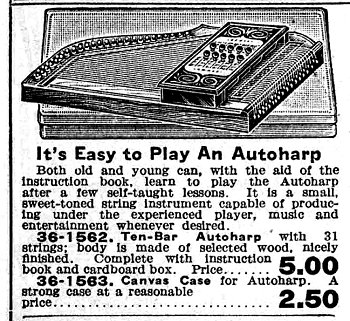 What is not in question is whether they were advertised in the Eaton catalog. The Eaton link is supported by their listings in several successive years of Eaton catalog. What is not in question is whether they were advertised in the Eaton catalog. The Eaton link is supported by their listings in several successive years of Eaton catalog.
So, all the sources (and hearsay) I could find place the manufacturing squarely in Canada. At a time when trade among the nations of the British "Commonwealth" required very little "red tape." That's probably why they turn up in England and "Down Under," but very seldom in the United States.
Obviously if you have any definitive information on the source of these, etc., please contact us, and we'll be sure to give you credit for your input.
Contemporary Competition
When these were first built, the most popular Zimmerman design was a 5-chorder that could play only in F and C. So this model was definitely better.
The next most popular Zimmerman model (the Model 73) could only play in F, C, and G, but it featured chords like Am and E7 that made it possible to play more complex songs in those keys. So It probably "won" the competition for anyone who didn't see the need to play in D.
But the biggest competition for autoharps of all kinds was the radio. And, eventually, the phonograph. Folks no longer had to depend on some family member learning a tricky - and possibly limited - instrument to have music in the home.
The only thing that kept Oscar Schmidt's autoharps from fading into obscurity was their adoption by string bands like the Carter Family. Had there been an analogous Canadian group that used the home-built autoharps in their music, whoever was building them may have been able to keep it up.
As it is, dozens of similar zithers, autoharps, psalteries, and related instruments faded into obscurity during the 1930s. I see this line as a valiant effort that offered ease of playing and more keys than the contemporary US-built autoharps, but which couldn't survive the overall decline of this form of entertainment.
Next Steps
If you've got this far, you've learned how much enjoyment you can get out of your autoharp and a few simple songs. Recommended next steps include:
- Our "Playing Autoharp Overview" article goes into more detail about playing more advanced songs in more advanced styles, including playing the tunes to songs, using fingerpicks.
The same article also provides links to several helpful videos that cover essentially the same content. So if what we wrote doesn't make any sense to you, the videos might.
- Our "Autoharp Repair Overview" article explains the basic workings of autoharps. Every autoharp owner winds up doing some minor repair on their instrument eventually. Hopefully this article (and others) will show you there's nothing to be afraid of.
- Our "Tweaking Autoharps Overview" explains the most common "hacks" people perform on their autoharps to make them more useful for their preferred style of music, etc. We don't recommend any of these to beginners, but some people do, so we're giving you this resource in case you want more information, or if you just want to know what terms like "semi-diatonic" mean.
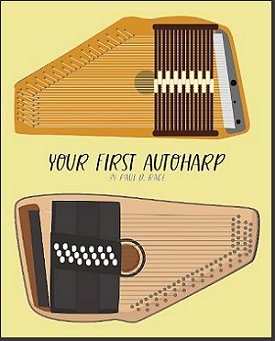 One other major resource is our downloadable book Your First Autoharp.. This is a result of years of answering user questions that, frankly, most autoharp books do not begin to address. One other major resource is our downloadable book Your First Autoharp.. This is a result of years of answering user questions that, frankly, most autoharp books do not begin to address.
Learning to play an autoharp that is in repair and perfect tune is one thing. Owning an autoharp, is another. Countless readers who have acquired autoharps through gifts, inheritance, thrift shops, auction sites, or impulse purchases have no idea where to begin, what to look for, how to troubleshoot minor issues, and so on.
Of course, we also have tips that ease you into playing all sorts of tunes. One reviewer has said it has more "meat and potatoes" than other, much more expensive books.
Please click on the picture for more information.
Other Publications - In addition to those online resources, many good instructional books and dvds are available. Check our "Autoharp Publications" page for details.
Conclusion
The most important thing is to have fun with your autoharp. There is no one "right way" to play it, no matter what some "experts" say. You learn all kinds of things about music just by playing one. In fact, a professional acoustic guitarist just told me that getting his hands on an autoharp when he was young taught him so much about music that he was motivated to take up guitar. Some 40 years later, he's the premier acoustic guitarist in our region.
So there's no downside and a lot of upsides to learning and playing autoharp.
And if you can jam with other people, that's even better.
 Whatever else you get out of our pages, I hope you come away with some great ideas for "sharing the joy." Whatever else you get out of our pages, I hope you come away with some great ideas for "sharing the joy."
And please stay in touch!
- Paul Race


|  > > |