Making Your OS 21-Chord Autoharp Folk- and Bluegrass-Friendly |
  |
|




| Editor's Note: As a Folksinger who sometimes sits in Bluegrass jams, and has any number of friends who play Country music, I find that standard autoharp settings are inadequate for a great deal of music in those genres. So I joined a long list of autoharp players who "tweak" their autoharps by adding chords they need and sacrificing chords they don't. The first article I wrote on this was actually based on an OS73C, a 21-chord Oscar Schmidt that was designed to look like the old black Model 73s that dominated the autoharp market between 1929 and 1960. It's a little different from all of Oscar Schmidt's other 21-chorders, though. Subsequently, I have attempted the same reconfiguration on an OS21, which is a much more common autoharp. I recorded a video at the same time, which I hope to make available soon. Because no video gives you all the resources you might need for this sort of thing, I'm adding an article specific to standard 21-chord Oscar Schmidts. At this time, I have "cheated" by borrowing some photos from the OS73C conversion, where the content overlapped. I hope to replace them with pictures from the OS21 soon, but this should give you enough to work with. - Paul Race
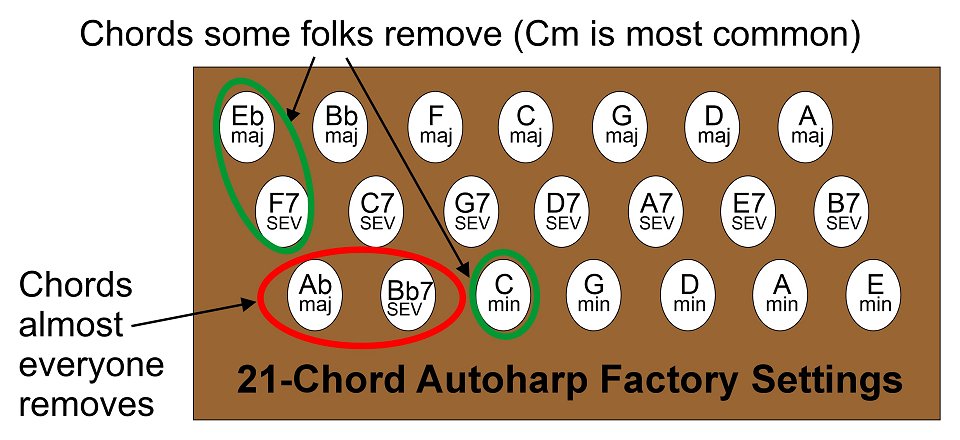
Making Your OS 21-Chord Autoharp Folk- and Bluegrass-FriendlyFor the first six decades of autoharp history, autoharps in the United States were designed and usually manufactured by German Americans who wanted their instruments to be useful in concert band settings, and weren't particularly interested in such "fringe" genres as Folk, Bluegrass, or Country. Of course the irony is that the autoharp often attracts people with exactly those interests. Then they are disappointed when they realize that even the big 21-chord autoharps are better at playing polka music than they are at playing James Taylor, Bill Monroe, or Johnny Cash. Modern 21-chord autoharps have chords like Ab and Bb7 that are almost never used. At the same time, they lack chords like E major, B minor and F# minor that are commonly used in genres that feature acoustic instruments like guitar, banjo, or mandolin. Musicians in such genres are far more likely to play songs in G, D, A, and E than they are in Eb or Bb, or even F. A Note About "Diatonic" Tunings - If most or all of your playing involves the same key or two, you might consider a "diatonic" or "semi-diatonic" tuning. Such tunings choose a limited number of chords, say, only the chords you need to play in G and D. They then retune the strings you don't need (say, Eb) to notes you do need (say, D or E). Then the chords you can play sound fuller, it's easier to play melodies, and having fewer muted strings reduces the "clacking" sound of your picks. Many folks who go diatonic do so with customized autoharps with fifteen chords or less, because the number of chords you need for a single key or two is limited. But some folks convert 21-chorders to "semi-diatonic" and add chords like Dsus4 that aren't ordinarily on autoharps at all. I you've never reconfigured an autoharp, I don't recommend this for your first conversion, but I thought it was worth mentioning if you If going "diatonic" or "semi-diatonic" appeals to you, please visit our "Diatonic Autoharps" page for an overview. Staying Chromatic, But With More Useful ChordsBack to a 21-chord chromatic, the following section discusses chords that most Folk, Bluegrass, or Country musicians think are "expendable," and what "missing" chords need to be added.
Most remove a third chord, choosing among Cm, F7, and Eb. Cm is the most common choice (though I generally remove F7 instead, because of a few songs that old-timey banjo players play in Cm.) Which "third chord" you remove depend in part on"
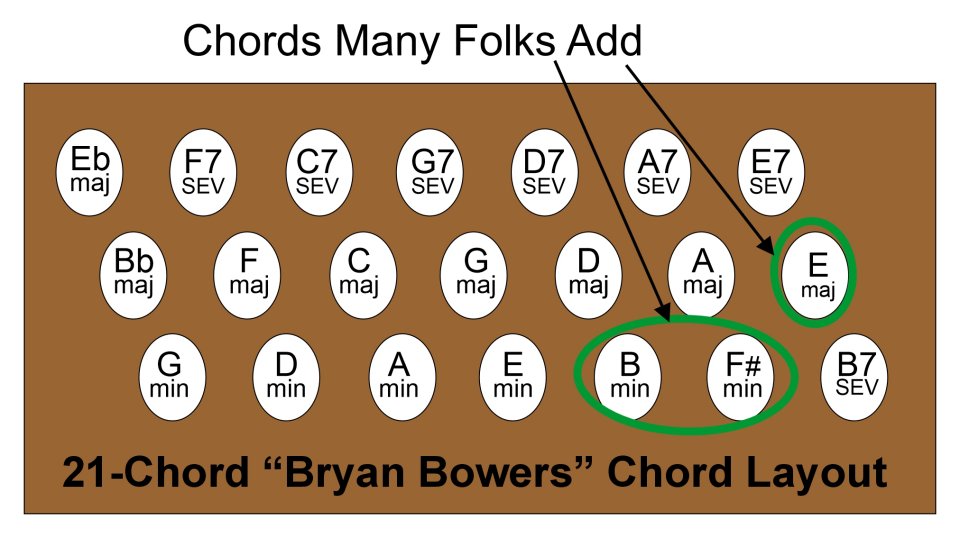
Adding E major allows you to play many 3-chord songs in E, a key that many Folk and Blues singers use, as well as some Country and Bluegrass songwriters. Adding Bm and F#m allows you to play 4-chord songs (like "Country Roads") in A, and more complex songs (like "City of New Orleans") in D. Other contenders include C#m, and the diminished 7th chords. (We don't include instructions for those, but if you know what diminished 7th chords are, you'll have little trouble figuring them out.)
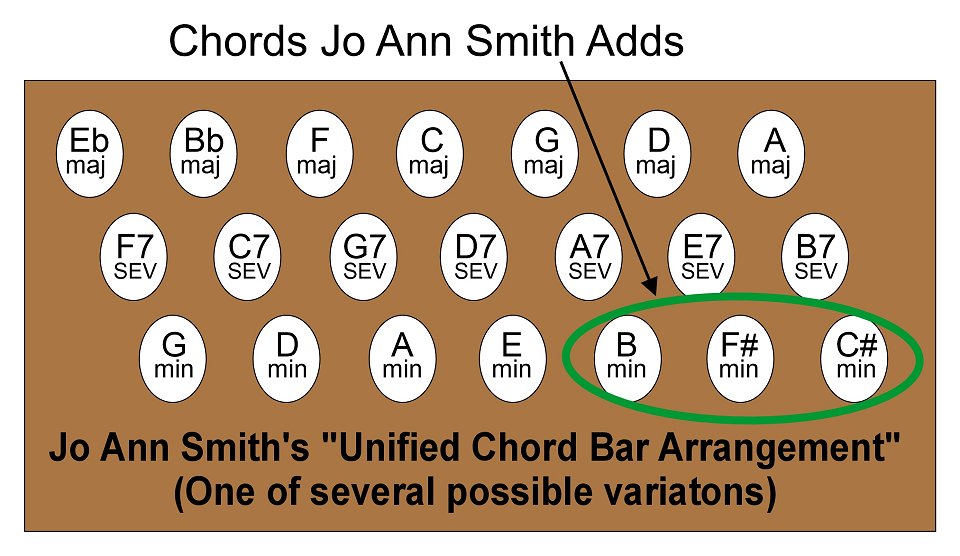
Of course, other configurations are possible. One configuration by well-known autoharper Jo Ann Smith is shown to the right. (She has other configurations, but this gives the general idea.) Jo Ann's approach is popular among folks who are generally satisfied with the OS21 arrangement, but just want more chords. It also would work much better on a 21-chord Chromaharp than a Bowers-inspired setup. Note about OS73C and OS73CE: All of the information above and most of the information below applies to the OS73C and OS73CE models as well, but there are several differences. For that reason, we have a separate article about reconfiguring those models here. About Replacement FeltThe least expensive and most You can buy felt in rolls (like that shown to the right) or in strips the length of a chord bar (not shown). Both kinds have stickum on the back for sticking to your chord bars once you've cleaned off the old felts. About Replacement Chord BarsSome folks get nervous about refelting their chord bars; perhaps being worried that they may really need Ab at some point in the future. If this is a concern, you can buy chord bars with the felt already applied.
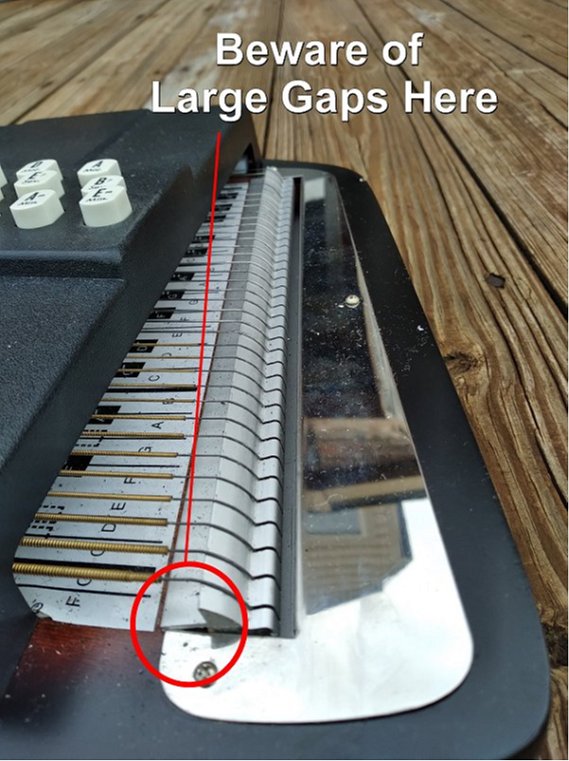
Be sure to buy the chord bar blanks for 21-chord Oscar Schmidt autoharps. 15-chord instruments use different chord bars. So do Chromaharp instruments. If you have an older autoharp, you may notice that the new chord bar blanks are 1/16" shorter than the old ones, and are more curved on the ends. They usually fit on the older 'harps, though. Is Your Autoharp Ready?The actual procedure I'm describring is pretty easy, once you get the hang of it. But most newbies to this sort of thing rightfully take a while the first time through. So before you get out the screwdriver, you might want to think about whether your autoharp is solid enough to justify this work. Ironically, having a newer autoharp doesn't necessarily mean you can ignore this section - the factories currently making autoharps are known for skimping on quality control.For example:
Should You Change the Strings? - You may want to change the strings on your autoharp at the same time. If the strings are sounding dull, or you just want to maximize your enjoyment of your autoharp, you may be considering a string change while you're doing the other work. Don't buy Oscar Schmidt strings, though. As of this writing Greg Schreiber makes the best replacement strings for your autoharp. If the wound (fat) strings sound dull and the rest sound good, Greg can even sell you just the wound strings. That said, I've come across 80-year-old autoharps that still sound great, because they've been stored properly. You can always decide on a string upgrade a month or a year from now if you want. Consider Ordering Buttons - At this moment (January, 2026), buttons for E, Bm, and F#7 are available online for a few dollars each. Again, the vendors keep shallow stock, so you may find yourself relabeling existing buttons. "Gotchas When Working on 21-chord OS Autoharps" - I will repeat this elsewhere, but you need to keep in mind:
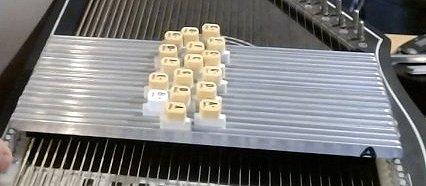
Disassembling the AutoharpFirst, tune your Autoharp. Then tune it again. Some of the later steps require testing chord bars to make certain they're playing the strings you want and dampening the strings you don't. If your Autoharp is badly out of tune, you can't really be sure.Carefully remove the four screws holding down the chord bar cover. Lift the chord bar cover very slowly, jiggling it lightly so the buttons don't all come off. You may need to push some of the buttons down as you're working. You need the buttons to stay in place until you're certain the chord bars have been labeled. When you have the cover safely off, look at the way the chord bars sit in the "comb." You'll see that each chord bar has a slot on one end and a hole on the other. That's how they need to go back in when you put things back together.
Unfortunately, it also means that they fall out easily. And that it's nearly impossible to take one chord bar out without also pulling out the button(s) next to it. That's why it's critical to make certain that the name of the chord is written on any chord bar you take out, whether you plan to keep that chord or not. When you pull any chord bar out, make certain the springs stay in place. Removing the FeltsIf you are refelting chord bars, you should be able to carve/slice the felt pieces off using a very sharp knife. Either way, you might find it helpful to use GooGone or mineral spirits or the like to get the rest of the glue/goo off the bars.Save at least a few of the felt bits - you never know when you might need to tweak some other chord bar. Replacing the FeltsFolks do this a few different ways.
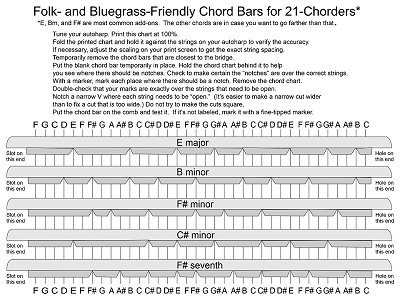
Note: The graphic includes two chord bars, C#m and F#7, that most people don't add to their autoharps. But some folks do, so we're providing them just in case. Fold the printed graphic and hold it over the strings on your autoharp to make certain the distance between the strings is correct. If not, you may need to reprint at 99% or 101% accordingly. Pull the last two or three chord bars off the autoharp to give you room to test and label your new chord bars. (Make certain they're labeled). Next, label the chord bar you're going to cut next into place on the comb on both ends. (Make certain you put the end with the hole on the correct comb.) Align the folded paper to make certain it aligns with the strings and put a mark each place on the chord bar where you will need a notch. Lay the paper aside and pluck each string that will be open once you cut the notches. You should be able to hear the chord. Remove the chord bar and cut a notch where the first line is, as shown in the photo below left. I always put the chord bar back in place and test it after the first cut to make certain things are lining up, and that I haven't cut it too narrow or too wide (too wide will allow the next string over to sound as well). You'll gradually accumulate a little pile of felt triangles. Keep a few handy, in case you cut a notch the wrong place, or cut a notch that's too wide and you need to glue a little felt in to fix your mistake. (I do this all the time, so don't feel bad.)
Eventually you'll have the whole chord bar cut (above right). Testing and Inserting the New Chord Bars To test each chord bar, put the new chord bar back on the comb temporarily. Then hold it down and pick each string to make certain the new chord bar is playing or dampening the correct strings. To test each chord bar, put the new chord bar back on the comb temporarily. Then hold it down and pick each string to make certain the new chord bar is playing or dampening the correct strings.
Repeat these steps for all of the new chords you're installing. Then, if you're doing a major reconfiguration like the Bowers-inspired suggestion above, carefully rearrange all of the chord bars into the sequence you need. As you put each chord bar into its new position, be certain that the bar is going the right direction (remember, there's a slot on one end and a hole on the other). Finally, make certain each button is sitting in the slot on the correct chord bar. And that it will be in the right "row" when the chord bar cover goes back on. Closing Up ShopOnce you have all your chord bars and buttons where you expect them to go, test every button to make certain it is playing the chord you think it is. Yes, it's "touchy" to do this without the chord bar cover in place. But it's a bigger pain to realize you've put the C7 button into the F chord bar after you've screwed the chord bar cover back into place. Also, this helps you make certain all of the springs are in place and that your new chord bars are doing the job they're designed for.
Settle the chord bar cover gently over the buttons. When the buttons have all popped through their appropriate holes, and the chord bar cover is sitting in place, test them again. Finally, screw the chord bar cover back down. Test every chord again. And retune. And play to your heart's content. ConclusionOnce you've done one of these reconfigurations, you may wonder what you were afraid of. I have done several similar projects while preparing for my autoharp clinics, and I frankly enjoy doing it.OS73C Tips - Once again, if you are tempted to do a similar reconiguration on an OS73C or OS73CE, you'll find instructions for that job here. Other Related Articles:
More to ComeAs I do more conversions and repairs, I expect this list of articles to continue growing. And keep playing, singing, and sharing, whatever else you do! Best of luck!
And please stay in touch! - Paul Race
>
|
|
All material, illustrations, and content of this web site is copyrighted ? 2001, 2002, 2003, 2004, 2005, 2006, 2007, 2008, 2009,
Note: Creek Don't Rise (tm) is Paul Race's name for his resources supporting the history and music of the North American Heartland as well as additional kinds of acoustic and traditional music. For questions, comments, suggestions, trouble reports, etc. about this page or this site, please contact us.
| |||||||||||||||||||||||||||||||||||||||||||||||||||||||||||||||||||||||