Click to go to the harpersguild.com(tm) home page

Other Autoharp Manufacturers


Click to visit RiverBoatMusic.com's autoharp buyers' guide.
Please Read: How to Help Our Site at No Cost to You - Some of our articles contain recommendations for products we like and vendors we personally trust. Some of those vendors may pay us a very small commission if you click on a link and buy their products. This costs you nothing at all and helps offset the costs of what we do. So if we point you to something you decide to buy later, please make certain you come back through our site and click on the link directly. Thanks.

This Site is a Cookie-Free Zone - Except for discussion forums that you have to expressly register for, none of our pages use cookies of any kind. Some of the vendors we link to do, but that won't affect you unless you click on a link to their pages. Your continued use of this page indicates that you agree to our policy. For details, click here.


Click to sign up for our newsletter about Folk, Roots, and Americana music.


Click to visit RiverBoatMusic.com's autoharp accessories page.


Click to visit RiverBoatMusic.com's acoustic guitar buyers' guides


Click to visit RiverBoatMusic.com's banjo buyers' guides


Other Autoharp Manufacturers

This article will address companies besides Chromaharp and the Zimmerman/Dolge/Phonoharp/Oscar Schmidt dynasty who mass-produced autoharps for a time at least.

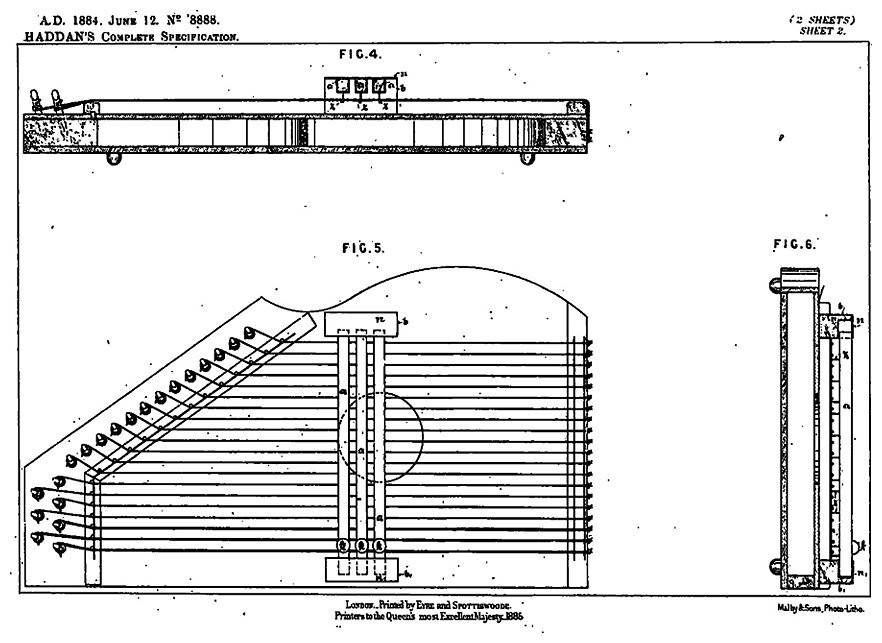
This is apparently a fax of a page from Gutter's patent application in Britain. Click for bigger photo.The claims of Zimmerman and his successors aside, we now know that the instrument we call the autoharp was invented by Karl August Gutter, of Markneukirchen, Germany. And that he sold his patent to another Bavarian, Herman Lindemann, up to two years before Zimmerman began making his autoharps and marketing them as though they were his invention.

We also knowthat countless builders besides Zimmerman began copying and enhancing Gutter's inventions almost immediately.

The Early Days

Markneukirchen, in Bavaria, was the home of countless musical instrument manufacturers, most of which were organized along guild or family lines. Violin glue formulas, brass tube bending techniques, and countless other "trade secrets" helped the guilds protect their monopolies against competition throughout Germany, and - in some case - surrounding regions.

But building autoharps and other chorded zithers seemed to be feasible for anyone with a wood shop. It's no wonder that so many folks who were basically locked out of the musical instrument manufacturing industry saw a way to turn a quick profit.

Unfortunately, the competition was steep, and most of those "fly-by-night" builders stopped making autoharps within a few years. But at least one Bavarian builder is still building today. And at least one design invented and built in Canada in the early 1900s had a good run.

Autoharp Archaeology

I'm unashamedly fascinated by history, including the history of obscure musical instruments. So when I see an autoharp (or zither, or psaltery, etc) that is unlike anything I've seen before, I usually try to learn something about it.

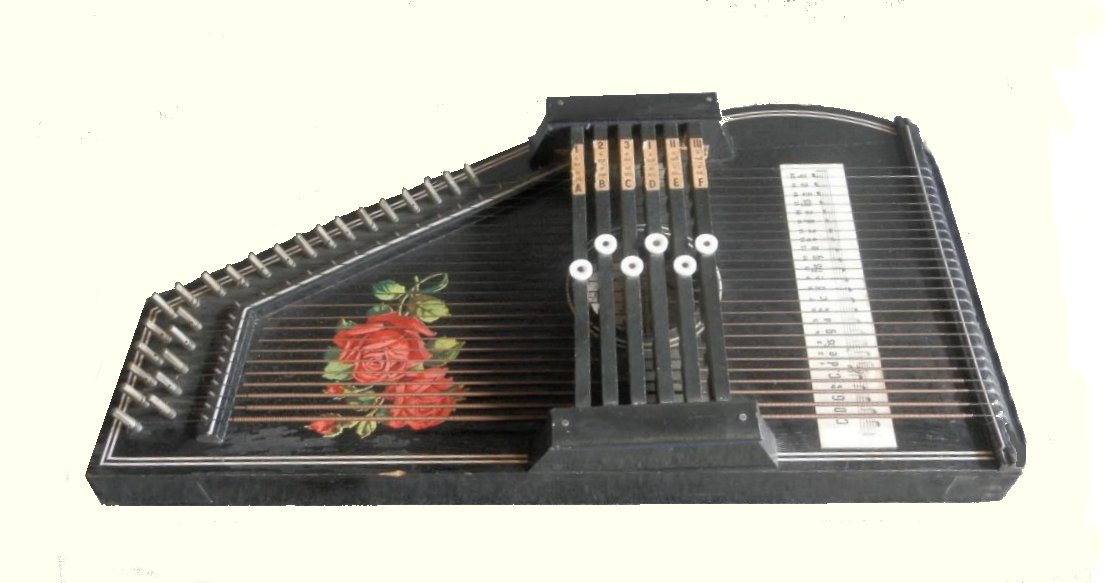
Often the first several things I "learn" about such instrument A pre-war Hopf-built autoharp, identifiable only through the Hopf family's iconic rose decal.  Click for bigger picture.are wrong, probably because someone took an educated guess, and subsequent folks assumed they knew what they were talking about.

The first "German Autoharp" I bought out of curiousity eventually led me to learn the story of the C.F. Hopf family. Although their family business has suffered "ups and downs," incuding nationalization by the German Democratic Republic, they have managed to build autoharps and zithers throughout the 20th century and they are still making them today.

Later I saw several Euro autoharps that looked specifically like later Hopf models, but with the "Musima" brand name. Turned out that they were Hopf-built, or at least Hopf-designed, but the GDR insisted they use the GDR's brand name.

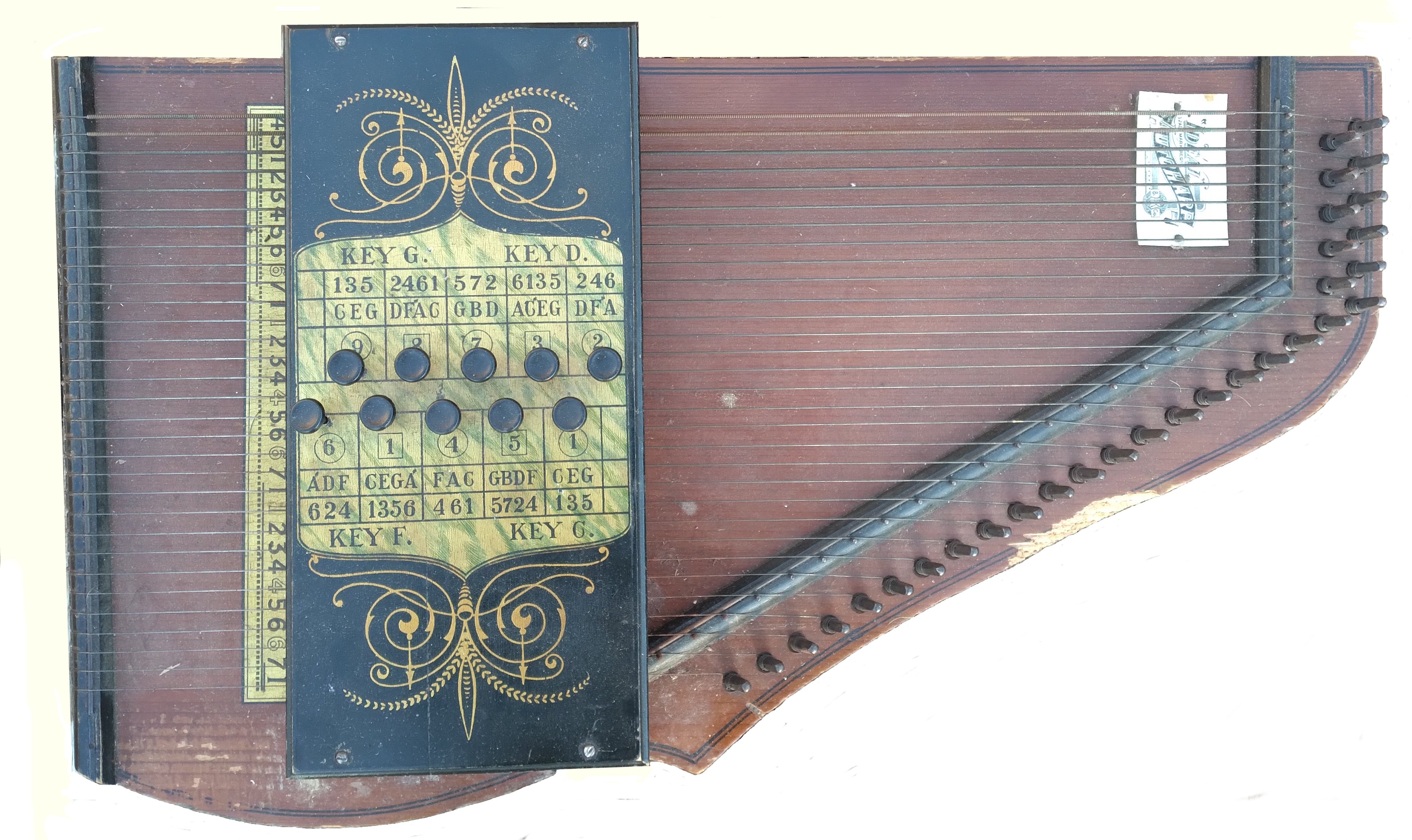
This is actually a bad example of a pushbutton autoharp that was made in Canada - it's chord button setup is 'backwards,' possibly for a left-handed person. Click for bigger picture.Some time later, I picked up an "Ideal" autoharp with an unusual button configuration. Despite the label, there were no actual manufacturer's markings on the thing. And, ironically, the model I found had been built or reconfigured for left-handers, something I didn't realize until I saw other examples, every one of which had the chord assembly turned 180 degrees from this one.

I never saw another example with the Ideal label, so that may have been added by a regional music store who was buying them wholesale and reselling them back in the day.

For a time, I was seeing more turn up in England than anywhere else, so I wondered if they were made in England. Then I saw examples turn up in Australia and New Zealand. and finally in Canada. Turns out they were built in Canada and sold by amail order catalog there, though the actual factory location is still unverified.

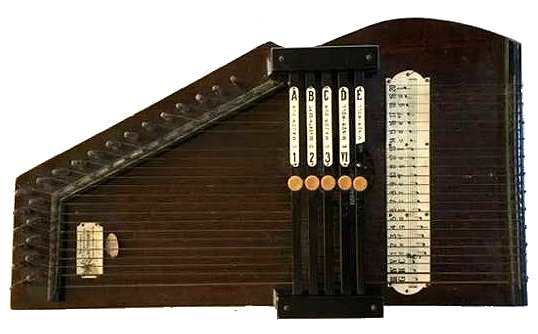
This early Meinhold autoharp seems similar to Zimmerman 5-chorders, but it's set up to play in C and G, not C and F.  Several of Meinhold's autoharps are quite impressive including one that used shifters to change the key of the chords.Another German model that turns up from time to time is the Meinhold. The first example I saw was nearly identical to the 6-chord Hopf autoharp above, except for the manufacturer's label and lack of decal. But Meinhold made several more elaborate autoharps, one of which would actually play in 12 different keys, if you could remember how to set it up for each key.

The "Loopholes" web page contains some history of this maker, who seemed to honor Lindemann's patent, while patenting several of his own tweaks, some of which were very elaborate.

Those mysteries solved, at least somewhat, there remain a large number of autoharps for which there is no certain identification.

Our Articles So Far

I'm sure we'll keep coming across autoharps we don't recognize, and researching them as much as we can. But in the meantime, here are three articles we've written on these obscure instruments so far:

Other Folks' Articles

The "Loopholes" web page has countless articles on the history of autoharps, zithers, and their builders. Specific information about the Meinhold autoharps is included here.

Conclusion

As mentioned above, there were many autoharp builders in the 1895-1930 era, most of which faded away quietly. As I see others come up I'll try to track them down. But I'd be glad for any readers to get in touch if you spot an unknown model in the wild I might have a bit of information that - put together with what you have found - may help us "nail down" another builder.

Next Steps

If you've got this far, you've learned how much enjoyment you can get out of your autoharp and a few simple songs. Recommended next steps include:

  • Our "Playing Autoharp Overview" article goes into more detail about playing more advanced songs in more advanced styles, including playing the tunes to songs, using fingerpicks.

    The same article also provides links to several helpful videos that cover essentially the same content. So if what we wrote doesn't make any sense to you, the videos might.

  • Our "Autoharp Repair Overview" article explains the basic workings of autoharps. Every autoharp owner winds up doing some minor repair on their instrument eventually. Hopefully this article (and others) will show you there's nothing to be afraid of.

  • Our "Tweaking Autoharps Overview" explains the most common "hacks" people perform on their autoharps to make them more useful for their preferred style of music, etc. We don't recommend any of these to beginners, but some people do, so we're giving you this resource in case you want more information, or if you just want to know what terms like "semi-diatonic" mean.

  • Click to learn more about our handbook.One other major resource is our downloadable book Your First Autoharp.. This is a result of years of answering user questions that, frankly, most autoharp books do not begin to address.

    Learning to play an autoharp that is in repair and perfect tune is one thing. Owning an autoharp, is another. Countless readers who have acquired autoharps through gifts, inheritance, thrift shops, auction sites, or impulse purchases have no idea where to begin, what to look for, how to troubleshoot minor issues, and so on.

    Of course, we also have tips that ease you into playing all sorts of tunes. One reviewer has said it has more "meat and potatoes" than other, much more expensive books.

    Please click on the picture for more information.

Other Publications - In addition to those online resources, many good instructional books and dvds are available. Check our "Autoharp Publications" page for details.

Conclusion

The most important thing is to have fun with your autoharp. There is no one "right way" to play it, no matter what some "experts" say. You learn all kinds of things about music just by playing one. In fact, a professional acoustic guitarist just told me that getting his hands on an autoharp when he was young taught him so much about music that he was motivated to take up guitar. Some 40 years later, he's the premier acoustic guitarist in our region.

So there's no downside and a lot of upsides to learning and playing autoharp.

And if you can jam with other people, that's even better.


Paul Race playing a banjo. Click to go to Paul's music home page.Whatever else you get out of our pages, I hope you come away with some great ideas for "sharing the joy."

And please stay in touch!

    - Paul Race Click to see Paul's music home page Click to contact Paul through this page. Click to see Paul's music blog page Click to visit the Creek Don't Rise discussion forum. Click to learn about our Momma Don't Low Newsletter. Click to see Paul's music page on Facebook Click to see Paul's YouTube Channel.

>

All material, illustrations, and content of this web site is copyrighted ? 2001, 2002, 2003, 2004, 2005, 2006, 2007, 2008, 2009,
2010, 2011, 2012, 2013, 2014, 2015, 2016, 2017, 2018, 2019, 2020, 2021, 2022, 2023, 2024, 2025, 2026 by Paul D. Race. All rights reserved.
Creek Dont' Rise(tm) is a participant in the Amazon Services LLC Associates Program, an affiliate advertising
program designed to provide a means for sites to earn advertising fees by advertising and linking to Amazon.com.

Note: Creek Don't Rise (tm) is Paul Race's name for his resources supporting the history and music of the North American Heartland as well as additional kinds of acoustic and traditional music.

For questions, comments, suggestions, trouble reports, etc. about this page or this site, please contact us.


Visit related pages and affiliated sites:
- Music -
Heartland-inspired music, history, and acoustic instrument tips.
Best-loved railroad songs and the stories behind them.
Learn important guitar chords quickly, to jump start your ability to play along on any song. With a few tools and an hour or two of work, you can make your guitar, banjo, or mandolin much more responsive.  Instruments with movable bridges can have better-than-new intonation as well. Resources for learning Folk Music and instruments quickly Check out our article on finding good used guitars.
Carols of many countries, including music, lyrics, and the story behind the songs. X and Y-generation Christians take Contemporary Christian music, including worship, for granted, but the first generation of Contemporary Christian musicians faced strong, and often bitter resistance. Different kinds of music call for different kinds of banjos.  Just trying to steer you in the right direction. New, used, or vintage - tips for whatever your needs and preferences. Wax recordings from the early 1900s, mostly collected by George Nelson.  Download them all for a 'period' album. Explains the various kinds of acoustic guitar and what to look for in each.
Look to Riverboat Music buyers' guide for descriptions of musical instruments by people who play musical instruments. Learn 5-string banjo at your own speed, with many examples and user-friendly explanations. Explains the various kinds of banjos and what each is good for. Learn more about our newsletter for roots-based and acoustic music. Folks with Bb or Eb instruments can contribute to worship services, but the WAY they do depends on the way the worship leader approaches the music. A page devoted to some of Paul's own music endeavors.
- Trains and Hobbies -
Free building projects for your vintage railroad or Christmas village.
Visit Lionel Trains. Click to see Thomas Kinkaded-inspired Holiday Trains and Villages. Big Christmas Train Primer: Choosing and using model trains with holiday themes Building temporary and permanent railroads with big model trains Click to see HO scale trains with your favorite team's colors.
- Christmas Memories and Collectibles -
Visit the FamilyChristmasOnline site. Visit Howard Lamey's glitterhouse gallery, with free project plans, graphics, and instructions. Click to return to the Old Christmas Tree Lights Table of Contents Page Click to sign up for Maria Cudequest's craft and collectibles blog.
Click to visit Fred's Noel-Kat store.
Visit the largest and most complete cardboard Christmas 'Putz' house resource on the Internet.
- Family Activities and Crafts -
Click to see reviews of our favorite family-friendly Christmas movies. Free, Family-Friendly Christmas Stories Decorate your tree the old-fashioned way with these kid-friendly projects. Free plans and instructions for starting a hobby building vintage-style cardboard Christmas houses. Click to find free, family-friendly Christmas poems and - in some cases - their stories. Traditional Home-Made Ornaments