OS Anchor Bar Issues |
 |
| 



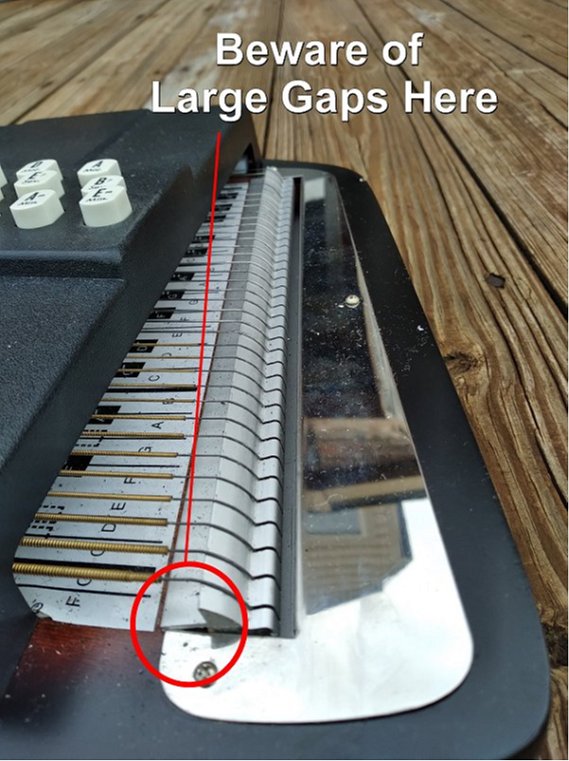
| OS Anchor Bar IssuesThis article is not to scare you away from autoharps - it's just our attempt to thoroughly explain a concern we mention in other articles, especially those about shopping for and maintaining new or newer Oscar Schmidt autoharps. An unfortunate manufacturing defect has been affecting Oscar Schmidt autoharps, especially in the last twenty years. This is not a reason to avoid Oscar Schmidt autoharps completely, but it's something to be aware of. It's also the reason our Autoharp Buyer's Guide recommends avoiding certain OS autoharps, especially for first-time buyers. It goes back to Oscar Schmidt's redesign in the late 1960s, resulting in the "Type B" autoharps that have been made ever since about 1969. Instead of a row of pegs to hold the end of the strings, "Type B" autoharps rely on a long aluminum piece with slots in it for holding the ends of the ball strings.  That piece is commonly called an "anchor bar." When it's doing it's job, it makes restringing an autoharp much easier than it used to be. But it's not fastened down. In the original design, the tight tolerances leveraged the string tension to keep it in place. Unfortunately, the companies that have owned the Oscar Schmidt name since the 1980s have been sending the actual manufacturing work to the lowest bidder in Asia. A few may initially have gone to Japan. I've heard those were pretty good, but haven't seen any myself. Then it was Korea, and most of those were pretty good, though some of those started having quality control issues toward the end. Then manufacturing went to various factories in China, and, frankly, all bets were off. Most of the autoharps that have come to me with anchor bar problems were definitely made in China. Each new factory interprets the specifications differently, with the result that chord bar length has changed, tuning peg diameter has shifted, and other all-but-invisible shifts have occurred. Most of these minor shifts in tolerances, etc. are invisible to most beginning autoharp owners, and very few actually affect playing or enjoyment.
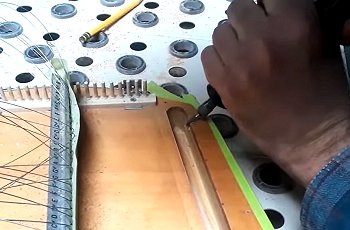
But in the last fifteen years or so, the Asian factories have been getting sloppy about the tolerances required to hold the anchor bar in place. On far too many recently manufactured autoharps, the strings have pulled it up far enough to warp the face of the instrument. Most people whose autoharps have this problem don't notice it until the damage is substantial. And by then it's usually fatal for the instrument. Hal Weeks, a top technician for autoharp luthier Pete D'Aigle,says he has seen this on OS Type Bs of all ages. In my far more limited experience, I've seldom seen it on autoharps older than 15 years. But if you own any autoharp with an anchor bar, keep an eye on it. And if you're looking to purchase a new Oscar Schmidt, keep this potential issue in mind. Hal has published a video that shows how to head the problem off before it causes damage or - better yet - before it has a chance to occur. At this time, 90% of the other resources that address this issue borrow Hal's process step by step, so I'll just keep referring to this video for the forseeabe future. When possible, Hal does this automatically for every OS "Type B" autoharp that comes across his path, especially if he's been tasked with changing the strings. The Fix
Hal's procedure usually takes place at the same time as a restringing and other maintenance. Consequently, it includes:
This is easier if the strings aren't in place. So consider doing this the next time you replace the strings, even if the anchor bar isn't showing a problem yet. Note: The list above is not an instruction sheet. We provided it just to help you see the most reliable way of heading this problem off before it starts (or becomes too bad, at least). Is This a Hoax?Every time this problem/potential problem comes up in a discussion group, certain autoharp owners who are lucky enough never to have experienced it claim that it's a hoax. Probably invented by people who want you to pay money for unnecessary repairs, or who want to "upsell" you to custom-built luthier instruments. Sadly, they're wrong. It's real. Two relatively new OS21s that came to me for "repair" were starting to have this problem, so I detuned them until I can get around to applying Hal's fix. (One of them is in the second photo on this page.) Worse yet,, the anchor bar on one relatively new OS21 I bought for parts had distorted the face of the instrument so far it had actually broken some of the "teeth" off the comb. The body is a "write-off," period. Thankfully, not every Oscar Schmidt with an anchor bar will experience this problem. But in my determination to give you all the information you need to make informed decisions, I have to tell you what I can. Recent UpdatesThen in early 2026, I heard that OS manufacturing might be going back to Korea, which would probably reduce quality issues. It's hard to know anything for certain, because Washburn (who owns the Oscar Schmidt brand name) is very tight-lipped about this sort of thing.In other words, the situation might be improving, but you still need to understand the issue, and - especially - check out anyautoharp you buy thoroughly as soon as it's in your hands, while you have time to return it. And if it has an anchor bar, keep a close eye on it going forward. ConclusionThe takeaway is that quality control isn't consistent from year to year. It may be improving. But we have no way to know for certain. Our priority is your enjoyment; we certainly do not want anything about your autoharp experience to be disappointing. And with your due dilligence, it doesn't have to be. Other Articles and ResourcesCurrent autoharp repair resources we offer include:
Third-Party Resources:
In addition, our articles on tweaking and reconfiguring autoharps also offer some tips that may help you get through repairs regarding chord bars, springs, etc. As I have time, I'll write more specifically about these problems and others you may encounter. In the meantime, I hope our available articles help answer your questions about these under-rated instruments.
And please stay in touch! - Paul Race
All material, illustrations, and content of this web site is copyrighted ? 2001, 2002, 2003, 2004, 2005, 2006,
For questions, comments, suggestions, trouble reports, etc. about this page or this site, please contact us.
| ||||||||||||||||||||||||||||||||||||||||||||||||||||||||||||||||||||||